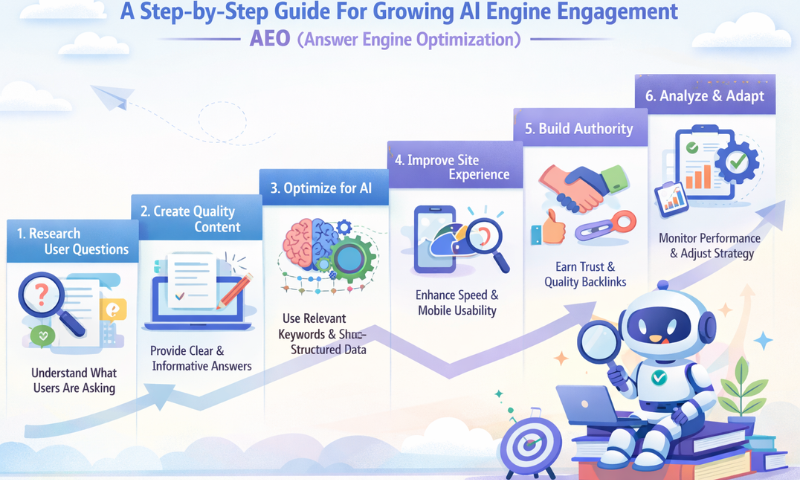
What is Answer Engine Optimisation (AEO)? AEO is the practice of optimising your website so that AI-powered answer engines — ChatGPT, Perplexity, Google AI Overviews, Claude, Bing Copilot — cite your content in their generated responses. Unlike traditional SEO (which targets search rankings), AEO targets AI citations. In 2026, over 50% of informational queries are now answered directly by AI without a click. If your content is not AEO-optimised, you are invisible to the fastest-growing discovery channel on the internet.
✓ What AEO is
✓ AEO vs SEO vs GEO
✓ Step-by-Step Tactics
✓ AEO Checklist
If you searched Google three years ago and ranked on page one, the traffic came automatically. People clicked your link, read your content, and you got the visit. That model is quietly breaking down. Today, millions of queries are answered by ChatGPT, Perplexity, Google AI Overviews, and Bing Copilot — directly, without a click ever happening.
The businesses showing up in those AI-generated answers did not get there by accident. They got there because someone optimised their content specifically for AI citation — not just for Google rankings. That practice has a name: Answer Engine Optimisation (AEO). This guide explains exactly what it is, how it differs from SEO, and the specific, actionable steps to start getting your content cited by AI platforms today.
What Is Answer Engine Optimisation (AEO)?
Answer Engine Optimisation (AEO) is the process of structuring and optimising your website content so that AI-powered platforms — called answer engines — can discover, understand, and cite it in their generated responses.
Answer engines include ChatGPT, Perplexity AI, Google AI Overviews, Microsoft Bing Copilot, and Claude. Unlike traditional search engines that return a list of links, answer engines synthesise information from multiple sources and deliver a single, direct answer. The sources they draw from — the ones they cite — are the sites that have been optimised for AEO.
The click-through model is changing — and most businesses are not ready
Google AI Overviews now appears on over 25% of all search queries in the US. Perplexity AI passed 100 million monthly active users in 2025. ChatGPT with browsing enabled is used by over 200 million people weekly. When these platforms answer a question, they cite 3–8 sources on average. If your site is not one of those sources, your competitor’s is. AEO is not the future of search — it is the present.
AEO vs SEO vs GEO: What’s the Difference?
These three disciplines are related but distinct. Understanding the difference is the first step to knowing where to focus your effort:
| Discipline | Full Name | Target Platform | Goal | Success Metric |
|---|---|---|---|---|
| SEO | Search Engine Optimisation | Google, Bing, Yahoo | Rank in search results pages (SERPs) | Keyword rankings, organic traffic |
| AEO | Answer Engine Optimisation | ChatGPT, Perplexity, AI Overviews | Get cited in AI-generated answers | AI citations, brand mentions in answers |
| GEO | Generative Engine Optimisation | All AI generative platforms | Appear in AI-generated content and summaries | Brand visibility in AI-generated text |
AI Crawlers: Who’s Visiting Your Site and What They Want
AI crawlers are automated bots deployed by AI companies to systematically browse and index web content. Unlike traditional search engine crawlers that prioritise ranking signals, AI crawlers gather content to train language models and populate knowledge bases. Knowing which ones visit your site — and what they are collecting — is the starting point for every AEO strategy.
| AI Platform | Crawler Name | User-Agent String | Block in robots.txt? |
|---|---|---|---|
| ChatGPT / OpenAI | GPTBot | GPTBot | ❌ Do not block |
| Perplexity AI | PerplexityBot | PerplexityBot | ❌ Do not block |
| Anthropic / Claude | ClaudeBot | ClaudeBot | ❌ Do not block |
| Google AI | Google-Extended | Google-Extended | ❌ Do not block |
| Meta AI | Meta-ExternalAgent | Meta-ExternalAgent | ❌ Do not block |
Many sites still have blanket Disallow: / rules or overly broad bot blocking that accidentally blocks AI crawlers alongside bad bots. Check your robots.txt right now. If GPTBot, ClaudeBot, PerplexityBot, or Google-Extended are blocked — you are invisible to those AI platforms. Being indexed by AI crawlers is a prerequisite for AEO, not optional.
How to Track AI Crawler Activity on Your Site
Understanding which pages AI crawlers visit most frequently is the foundation of a data-driven AEO strategy. There are two approaches:
Most granular method. Access via hosting control panel, parse using Screaming Frog Log Analyser, Botify, or Semrush. Filter by AI user-agents to see which pages each crawler visits and how frequently.
Plugin that automatically detects and reports AI crawler visits via a dashboard. No server access needed. Tracks GPTBot, PerplexityBot, ClaudeBot with page-level data. Ideal for content-focused teams.
How to Optimise Content for AI Citations (What SEJ Missed)
Tracking AI crawlers tells you what AI engines are already interested in. Optimising your content for AI citation tells them why they should cite you over someone else. These are the content-level tactics that most AEO guides — including the Search Engine Journal article this guide is built around — do not cover deeply enough.
Write Direct Answers First, Context Second
★ Highest Impact
AI engines are optimised to extract direct, clear answers to specific questions. They do not like long introductions before the point. Structure your content so the clearest, most direct answer to the page’s primary question appears in the first 2–3 sentences of each major section — before any context, explanation, or qualifications.
Use Question-Based H2 and H3 Headings
★ High Impact
AI engines map user questions to page sections. When your headings are phrased as questions — exactly as a user would type them — the probability of that section being extracted and cited jumps significantly. Align your headings with People Also Ask (PAA) questions and the actual queries your target audience types.
Implement FAQPage and HowTo Schema on Every Relevant Page
★ High Impact
Schema markup is how you communicate your content’s structure to AI systems in machine-readable format. FAQPage schema directly tells AI engines “here is a question and here is my answer” — making it trivial for them to extract and cite your content accurately. HowTo schema does the same for step-based content. These are the two highest-impact schema types for AEO specifically.
Build Topical Authority Through Content Clusters
△ Medium Impact
AI engines favour sources that demonstrate deep, comprehensive knowledge of a topic — not sites that cover a little of everything. A site with 20 interlinked articles all about technical SEO will be cited for technical SEO questions far more often than a site with one article about technical SEO among hundreds of unrelated topics. Build topic clusters: one pillar page, multiple supporting articles, strong internal linking.
Publish Original Data, Research, and Statistics
★ Very High Impact
When AI engines answer questions that require data or statistics, they cite primary sources — the sites that published the original research. Being a primary source is the highest-leverage AEO tactic available. Even small-scale surveys (100–500 respondents), original case studies, or proprietary data analysis makes your site a citation target that other sites then reference. AI engines reference primary sources at significantly higher rates than secondary aggregators.
E-E-A-T: The Credibility Signal AI Engines Weight Most
This is the section most AEO guides skip entirely. AI engines do not just cite any well-formatted content — they prioritise content from sources they can verify as credible, authoritative, and trustworthy. Google’s E-E-A-T framework (Experience, Expertise, Authoritativeness, Trustworthiness) is not just a Google ranking concept in 2026. It is the credibility framework that AI platforms use to filter which sources to cite.
Your brand’s visibility in LLM training data is your real AEO score
ChatGPT, Claude, and Gemini were trained on web data up to specific cutoff dates. How frequently and credibly your brand was mentioned in that training data — in articles, forums, Reddit threads, industry publications — determines how those models weight your content. This means brand PR and community presence are now directly AEO-relevant. Earning mentions on Reddit, Quora, industry forums, and high-authority publications is not just reputation management — it is LLM seeding that influences AI citation probability.
- ✓Every article has a named author with a verifiable bio page, LinkedIn profile, and credentials — AI engines check author credibility before citing
- ✓Organization schema on your homepage with consistent NAP data matching your Google Business Profile, LinkedIn, and Crunchbase listings
- ✓Content cites authoritative external sources (peer-reviewed research, official guidelines, recognised institutions) — credibility by association
- ✓Your brand is mentioned in community spaces AI trains on — Reddit, Quora, industry forums, niche publications — not just your own website
- ✓Consistent brand entity across Google Business Profile, LinkedIn, Crunchbase, Wikipedia (if eligible), and relevant industry directories
Using AI Crawler Data to Build Your AEO Content Blueprint
Once you are tracking AI crawler activity, the real optimisation work begins. AI crawler data transforms your content strategy from guesswork into a data-driven system. Here is the exact process:
How to Measure AEO Performance (What Most Guides Skip)
AEO is harder to measure than traditional SEO — there is no single ranking report. But there are clear signals you can track to know whether your AEO strategy is working:
| Metric | How to Track | Frequency |
|---|---|---|
| AI crawler visit frequency | Server logs or SEO Bulk Admin plugin | Monthly |
| Direct brand mentions in AI answers | Manual prompt testing in ChatGPT, Perplexity, Gemini | Monthly |
| Referral traffic from Perplexity.ai | Google Analytics — referral source: perplexity.ai | Weekly |
| Referral traffic from ChatGPT.com | Google Analytics — referral source: chatgpt.com | Weekly |
| Google AI Overview appearances | Manual search testing for target queries | Monthly |
| Rich result eligibility (schema) | Google Rich Results Test, Google Search Console | Quarterly |
The Complete AEO Checklist for 2026
Use this as your AEO audit framework. Work through each section systematically — Technical first, then Content, then Authority.
🔧 Technical AEO
- ☐robots.txt allows GPTBot, PerplexityBot, ClaudeBot, Google-Extended, Meta-ExternalAgent
- ☐XML sitemap is clean, submitted, and contains only canonical indexable URLs
- ☐AI crawler activity is being tracked (server logs or SEO Bulk Admin)
- ☐HTTPS enforced site-wide with no mixed content issues
- ☐Core Web Vitals passing — LCP under 2.5s, INP under 200ms, CLS under 0.1
📝 Content AEO
- ☐Every page answers its primary question in the first 2–3 sentences, before context or qualifications
- ☐H2/H3 headings are phrased as questions matching real user search queries
- ☐FAQ sections added to all informational and service pages
- ☐Content uses short paragraphs (3–4 sentences max), bullet points, and tables for scannability
- ☐Original data, research, or unique statistics published and kept up to date
- ☐Content clusters built around core topic pillars with strong internal linking
🏆 Schema & Authority AEO
- ☐FAQPage schema on all pages with Q&A sections
- ☐Article schema with author, datePublished, and publisher on all blog posts
- ☐Organization schema on homepage with verified NAP data
- ☐Named author bios with verifiable credentials on all content
- ☐Brand mentioned on Reddit, Quora, industry forums, and authoritative publications
- ☐Third-party reviews on Google Business Profile, Trustpilot, or industry review platforms
Frequently Asked Questions
Rankosys specialises in SEO, AEO, and GEO. We help businesses get cited by AI platforms — not just ranked on Google. Full technical audit, schema implementation, content restructuring, and AI citation tracking. No fake promises. Real, measurable results.