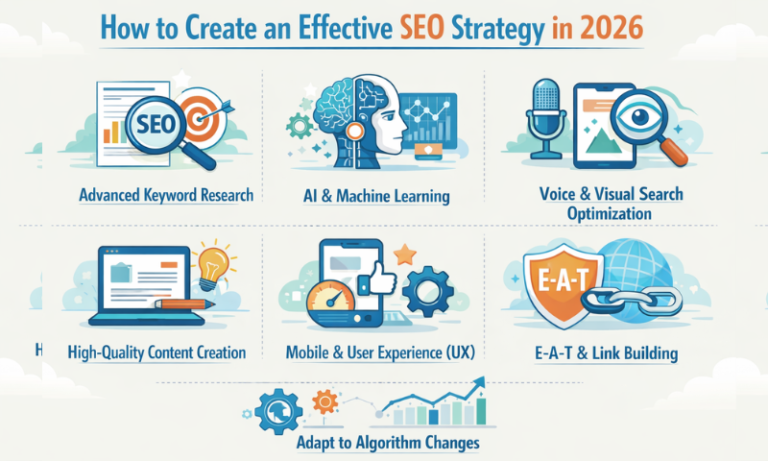
To do SEO for a new website in 2026: choose an SEO-ready platform (WordPress), run keyword cluster research by intent, build a silo site architecture, establish E-E-A-T signals, optimize every page technically, create AEO-structured content with schema, earn quality backlinks, set up Google Search Console + GA4, optimize your Google Business Profile, and implement GEO strategies for AI search visibility. First meaningful results appear in 3–6 months with consistent execution.
🤖 AEO + GEO Included
⚡ 2026 Algorithm Ready
🎯 Zero to Rankings
Launching a new website without an SEO strategy is like opening a physical store with no signage, no address on Google Maps, and no way for customers to find you. The store might be excellent, but if no one can find it, none of that matters.
Here’s the thing most guides don’t tell you upfront: SEO for a new website in 2026 is harder than it’s ever been — and also more rewarding than it’s ever been. Harder because Google’s standards are higher, AI search adds an entirely new visibility layer, and competition is intense in almost every niche.
More rewarding because a site built correctly from day one compounds its organic traffic faster, earns AI search citations earlier, and builds genuine authority that pays dividends for years.
This guide covers everything, from the first technical decision you make before publishing a single page to the AEO and GEO strategies that will determine whether your content appears in ChatGPT and Google AI Overviews. No fluff. No filler. Just the complete picture of what new website SEO actually requires in 2026.
Most new-website SEO guides cover the basics, keywords, meta tags, backlinks. What they miss: AEO content structuring for Google AI Overviews, GEO brand footprint for ChatGPT/Gemini citations, E-E-A-T author credentialing for YMYL industries, Core Web Vitals as a ranking signal, topical authority clustering vs. isolated keywords, and the critical difference between ranking on Google and being cited in AI search. This guide covers all of it.
Choose an SEO-Ready Platform and Hosting
Your platform choice is the first and most consequential SEO decision you’ll make. It determines your access to technical SEO controls, custom schema markup, robots.txt, .htaccess redirects, Core Web Vitals optimization, and plugin ecosystems. Getting this wrong at launch means retrofitting technical infrastructure later, which is significantly more expensive and time-consuming.
For WordPress, pair it with fast, managed hosting, Cloudways, Kinsta, or WP Engine. Install Rank Math or Yoast SEO for meta tag and schema management. Install a caching plugin (WP Rocket or LiteSpeed Cache). Use a theme that scores 85+ on Google PageSpeed Insights out of the box.
Build a Keyword Cluster Strategy (not just keywords).
The era of targeting individual keywords is over. In 2026, Google understands topics, not just terms. A new website needs a topical cluster strategy: one authoritative pillar page targeting a broad topic, supported by 6–10 cluster articles covering sub-topics, all internally linked in a hierarchy. This structure signals topical expertise to Google and compresses the time it takes to rank.
Must Read: Keyword Mapping Guide
For keyword research tools, use Ahrefs, Semrush, or Google Keyword Planner. Filter for keywords with Keyword Difficulty (KD) under 30 for a new domain — you can’t compete for KD 70+ terms from day one. Start with long-tail queries (3–5 words) in your niche and build toward broader terms as your domain authority grows.
Build an SEO Silo Architecture (Structure Before Content)
Site architecture is one of the most underappreciated SEO factors for new websites. A flat, logical hierarchy helps Googlebot crawl every page efficiently, distributes authority through internal links, and gives users an intuitive navigation path. The goal: every page reachable within 3 clicks from the homepage.
├── seo-services/ (Pillar Page — broad keyword)
│ ├── local-seo/ (Cluster — sub-topic)
│ ├── technical-seo/ (Cluster — sub-topic)
│ └── seo-for-startups/ (Cluster — sub-topic)
├── content-marketing/ (Pillar Page)
│ ├── blog-strategy/
│ └── content-for-seo/
└── blog/ (Supporting articles — link up to pillars)
Every cluster article links back to its pillar page with a consistent anchor text. The pillar page links down to each cluster article. This two-directional linking creates a closed loop of authority within each topic silo — meaning Google can recognize your site as authoritative on that topic without relying on external links to validate it.
Build E-E-A-T Signals From Day One
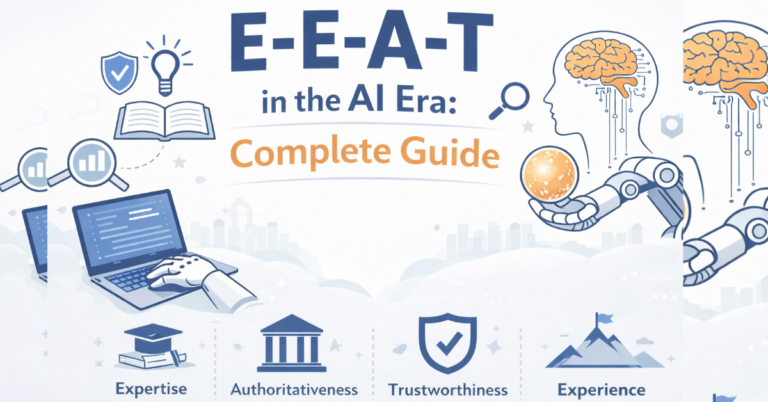
Google’s E-E-A-T framework (Experience, Expertise, Authoritativeness, Trustworthiness) is the evaluation standard for whether your content deserves to rank. For new websites — especially in YMYL (Your Money or Your Life) niches like healthcare, finance, or legal — E-E-A-T isn’t optional. It’s the baseline Google requires before your content gets meaningful visibility.
Master On-Page SEO — Every Element, Every Page
On-page SEO is the set of optimizations you control directly on each page. In 2026, this goes beyond title tags and keyword placement — it includes semantic content structure, image optimization, Core Web Vitals, and the signals that determine whether Google surfaces your content as a featured snippet or AI Overview result.
Technical SEO — Fix What Google Can’t Crawl
Technical SEO is the invisible layer that either enables or blocks everything else you do. A site with brilliant content and strong backlinks will underperform if crawling is blocked, pages are slow, or the mobile experience is broken. In 2026, Google’s Core Web Vitals are a confirmed direct ranking factor, meaning technical performance is no longer just a user experience consideration.
Create AEO-Structured Content That Earns AI Citations
This is the step that separates a 2026 SEO strategy from a 2022 one. Answer Engine Optimization (AEO) means structuring your content so that Google AI Overviews, ChatGPT, Perplexity, and Gemini can extract, understand, and cite it when users ask relevant questions. AEO is not separate from content creation — it’s a layer of structure applied to everything you publish.
Build Quality Backlinks — Authority You Can’t Fake
Backlinks remain one of Google’s top 3 ranking signals in 2026. For a new website with zero domain authority, the question isn’t “how many backlinks do I need?” — it’s “which types of backlinks will build genuine trust fastest?” The answer is quality over volume, relevance over raw metrics, and earned links over manufactured ones.
Set Up Google Search Console, GA4, and Your Data Foundation
You cannot optimize what you don’t measure. Google Search Console (GSC) and Google Analytics 4 (GA4) are both free and both non-negotiable from day one. GSC tells you how Google sees your site — indexing status, crawl errors, Core Web Vitals, and crucially, which queries are generating impressions but not clicks (your highest ROI optimization targets). GA4 tells you what users actually do when they arrive.
Optimize Your Google Business Profile (Local Businesses)
For any business serving a local area—dental practices, law firms, HVAC companies, restaurants, healthcare clinics — Google Business Profile (GBP) optimization is arguably the highest-ROI SEO action available. The Google Map Pack appears above all organic results for local searches and captures 44% of all clicks. A fully optimized GBP is how you get there.
- ✓ Claim and verify your GBP listing at business.google.com
- ✓ Fill every field: business description, services, hours (including holidays), photos
- ✓ Add 10+ real photos of your location, team, and products/services from launch day
- ✓ Set up a post-appointment review request via text/email — target 5+ new reviews monthly
- ✓ Respond to every review within 48 hours — positive and negative
- ✓ Build consistent NAP (Name, Address, Phone) citations across Yelp, BBB, and industry directories
- ✓ Add LocalBusiness schema to your website’s homepage and contact page
Distribute and Amplify Your Content (Initial Traffic Signals)
New websites face a classic challenge: your content is excellent but Google hasn’t seen enough signals to trust it yet. Content distribution — getting real people to read, share, and link to your work — sends early engagement signals that accelerate Google’s trust-building timeline. This isn’t about gaming the algorithm; it’s about making sure your genuine value reaches the audiences that need it.
Best for B2B, professional services. Share key insights from each article as a standalone post — link in comments.
Find subreddits where your audience is. Answer questions genuinely, link to your content where directly relevant. High-quality referral traffic that also signals relevance to Google.
Algorithm-proof. Even a list of 500 engaged subscribers sends meaningful initial traffic to each new post — and early clicks signal relevance to Google within 48 hours of publish.
Turn every major guide into a companion video. YouTube ranks in Google search results for video-friendly queries — doubling your SERP footprint for the same content investment.
Answer questions in your niche with genuine value. Add a relevant link when it adds context. Quora content ranks well and drives qualified referral traffic for years.
Slack groups, Discord servers, and niche forums in your space. Share your best content where it’s genuinely relevant — builds both referral traffic and early backlinks.
Monitor, Iterate, and Compound — SEO Is Never “Done”
SEO is a compounding investment, not a one-time project. The sites that dominate organic search aren’t those that launched perfectly, they’re the ones that published consistently, fixed what wasn’t working, and built on what was. Monthly optimization review is the habit that separates sites with compounding traffic growth from those that plateau after 6 months.
Realistic New Website SEO Timeline
The sites that grow fastest in 2026 aren’t the ones with the biggest budgets or the most content. They’re the ones that build technical foundations correctly from launch, target realistic keyword clusters with consistent publishing, structure everything for both traditional SEO and AI answer engine optimization, and review + iterate monthly. That combination — technical rigor + AEO structure + consistent execution — is the actual compounding mechanism behind every organic success story.
Frequently Asked Questions
For most new websites, first meaningful keyword movements appear in 3–6 months when technical SEO and content are done correctly from launch. Full competitive rankings for main commercial keywords take 9–18 months depending on niche competitiveness and domain authority. Businesses that invest in quick-win technical fixes in month 1 see early GSC movements within 30–60 days, which builds momentum for the longer-term strategy.
Quality over quantity is the 2026 standard. Two comprehensive 1,500–2,500 word posts per month that properly target keyword clusters, include FAQ schema, and demonstrate E-E-A-T will outperform eight thin 500-word posts every time. Google’s Helpful Content standards reward content that genuinely satisfies user intent — not content volume. Publish consistently rather than in bursts, and prioritize refreshing existing content alongside creating new pieces.
AEO (Answer Engine Optimization) focuses on structuring your content to appear in AI-generated answers — Google AI Overviews, featured snippets, voice search, and ChatGPT/Perplexity direct citations. It’s primarily a content structure and schema markup discipline. GEO (Generative Engine Optimization) is broader — it’s about building your brand’s overall digital authority footprint so that AI language models have enough reference data across the web to recommend and mention your brand by name when users ask relevant questions.
Not immediately — but within the first 60–90 days, yes. Before pursuing backlinks, your technical foundation and initial content need to be in place: GSC verified, pages indexed, site speed passing, schema live. Then start with the easiest, highest-trust links: local citations (for local businesses), industry directory listings, and HARO/Qwoted media responses. Guest posts and digital PR campaigns work best once you have 10+ high-quality published pieces for editors to evaluate your credibility.
Yes — for most use cases. WordPress offers the most complete set of SEO controls of any platform: fully customizable URLs, custom schema markup via plugins, complete robots.txt and .htaccess control, advanced caching and CDN options, and the most mature ecosystem of SEO plugins (Rank Math, Yoast). For eCommerce-only purposes, Shopify is a strong alternative. For design-first agencies, Webflow is competitive. For anything requiring complex SEO at scale, WordPress remains unmatched.
If you have the time and willingness to learn, this 12-step guide gives you everything needed to build a strong SEO foundation yourself. Where agencies earn their value: technical auditing requires experience to interpret correctly, keyword cluster strategies benefit from tool access and pattern recognition, AEO and GEO optimization requires up-to-date expertise that most non-specialists don’t have, and consistent monthly execution — content, links, reporting — is genuinely time-intensive. For competitive niches, agencies with industry specialization compress your timeline significantly and protect against the costly mistakes that slow most DIY efforts.
This Guide For Your Website?
Rankosys builds new website SEO strategies that cover all 12 steps — from technical foundation to AEO/GEO optimization — in one transparent monthly plan. Start with a free SEO audit: we’ll review your current setup and give you a clear roadmap for growth.
No contracts. No setup fees. First results in 30–90 days.
From $249/month · US, UK & Global · SEO + AEO + GEO