
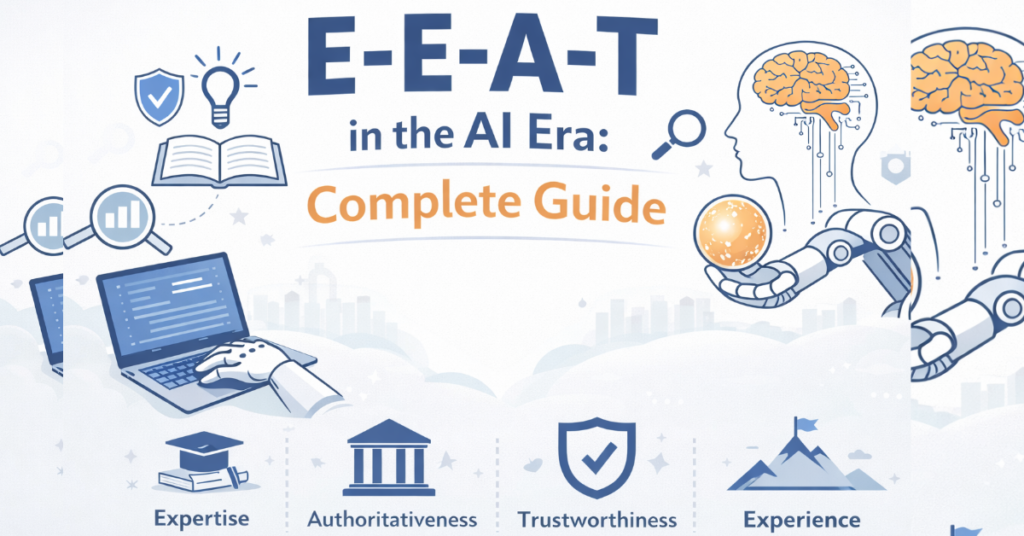
What is Google E-E-A-T? Google E-E-A-T stands for Experience, Expertise, Authoritativeness, and Trustworthiness. It is Google’s quality framework from the Search Quality Rater Guidelines for evaluating whether content is credible, helpful, and worthy of ranking. In December 2022, Google added the first “E” for Experience to the original E-A-T. In 2026, E-E-A-T also governs your visibility in AI-generated answers from ChatGPT, Perplexity, Gemini, and Claude.
✓ Confirmed by Google
△ Debated / Mixed
★ AEO / GEO Signal
Google’s E-E-A-T framework is one of the most discussed — and most misunderstood — concepts in SEO. Most guides treat it as a box-ticking checklist. It is not. E-E-A-T is a quality philosophy that must be embedded into everything you publish, and in 2026 it extends beyond Google into AI search platforms that determine whether your brand gets cited, summarised, or ignored entirely.
The Four Pillars of E-E-A-T
Each letter evaluates a different dimension of content quality. Here is what Google actually means by each one:
Google’s Quality Rater Guidelines explicitly state that Trustworthiness is the most important E-E-A-T dimension. A site with strong experience and expertise can still rank poorly if trust signals — accuracy, transparency, site security — are weak.
Year E-A-T was introduced in Google’s Quality Rater Guidelines
Year Google added “Experience” — upgrading E-A-T to E-E-A-T
E-E-A-T now governs AI search visibility (AEO & GEO)
3 E-E-A-T Myths That Hurt Your Strategy
E-E-A-T Is a Direct Ranking Factor
△ Misconception
E-E-A-T is not a direct ranking signal in the way backlinks or page speed are. Google’s Quality Raters assess content using E-E-A-T, and their ratings help train Google’s algorithms — but individual ratings do not directly change page rankings. Think of E-E-A-T as the standard the algorithm was trained to recognize, not a metric it directly measures on every crawl.
E-E-A-T Is a One-Time Checklist
△ Misconception
E-E-A-T is a quality philosophy embedded in everything you publish — and it looks different for every niche, audience, and content type. What builds authority for a finance site is irrelevant to a travel blog. There is no universal checklist.
Formal Credentials Are Always Required
△ Misconception
Google’s addition of Experience signals that lived, first-hand knowledge often equals formal credentials for many topic types. Context determines which type of expertise Google prioritizes — only YMYL content strictly requires formal credentials.
Many sites add generic author bios, stock profile photos, or fabricated credentials. Google’s Quality Raters are trained specifically to detect this. Only genuine, verifiable signals build real E-E-A-T.
E-E-A-T in AI Search: What Most Guides Miss
Most E-E-A-T guides focus almost entirely on Google rankings. This misses a critical dimension: E-E-A-T is now the primary framework that governs AI search visibility.
E-E-A-T Signals Weight Differently in AI Search
Traditional guides focus on backlinks and author bios. But AI platforms like ChatGPT, Perplexity, Claude, and Gemini evaluate credibility differently — Reddit and forum mentions, review site presence, entity consistency, and structured data carry especially high weight, often more than traditional backlinks.
| Signal | Google SEO | AEO (Answer Engines) | GEO (Generative) |
|---|---|---|---|
| Backlinks | ✓ Critical | △ Moderate | △ Less direct |
| Named expert authors | ✓ Important | ✓ Important | ✓ Very important |
| Reddit & forum mentions | △ Indirect | ★ High — LLM data | ★ Very high |
| Review site presence | △ Trust signal | ✓ High weight | ✓ High weight |
| Schema / Structured data | ✓ Rich results | ✓ Critical for parsing | ✓ Critical for parsing |
| Entity recognition | △ Indirect | ★ Central signal | ★ Central signal |
| Consistent brand data | ✓ Local SEO | ✓ Entity verify | ✓ Entity verify |
Your Brand Visibility in LLM Training Data Is Your Real AI E-E-A-T Score
ChatGPT and Claude were trained on web data up to a cutoff date. Your brand’s visibility in that training data — the quality and frequency of mentions in credible sources — significantly affects how models weight your content. Brand building and PR are now directly SEO-relevant. Earning mentions in high-quality publications and industry resources is LLM seeding.
Optimising for AEO (Answer Engine Optimisation)
- ✓Write content that directly answers specific questions in the first 1–3 sentences of each section
- ✓Use FAQ schema and HowTo schema to make your answers machine-parseable
- ✓Structure pages with clear H2/H3 hierarchy aligned to question intent
- ✓Earn mentions on Reddit, Quora, and niche forums — heavily weighted in LLM training data
Optimising for GEO (Generative Engine Optimisation)
- ✓Publish original data, research, or statistics that other sites will cite — become a primary source
- ✓Build entity associations through consistent structured data across all platforms
- ✓Implement comprehensive Schema: Article, Organization, Person, FAQPage, HowTo, BreadcrumbList
- ✓Earn citations from domain-authority publications that generative engines use as trusted seeds
The Complete E-E-A-T Signal Map
| Dimension | On-Page Signals (what you control) | Off-Page Signals (what others say) |
|---|---|---|
| Experience | First-person accounts, original photos, personal case studies, honest negative reviews | User reviews, community mentions, customer testimonials on third-party sites |
| Expertise | Author bio pages with credentials, expert review bylines, content depth and accuracy | Published works, media quotes, academic citations, speaker bios at events |
| Authoritativeness | Topical content clusters, internal linking depth, original research and unique data | Backlinks from authoritative sources, press mentions, industry recognition |
| Trustworthiness | HTTPS, transparent About page, affiliate disclosures, accurate contact info | Trustpilot / Google reviews, Clutch / G2 profiles, BBB listing |
How to Build E-E-A-T: 9 Actionable Steps
E-E-A-T Red Flags to Fix Now
| # | Red Flag | Why It Hurts | Fix |
|---|---|---|---|
| 1 | Anonymous or fake author bylines | Quality Raters cannot verify expertise; trust collapses | Real named authors with verifiable profiles |
| 2 | Stale content with outdated statistics | Accuracy is a core trust signal — old data signals neglect | Audit content twice yearly |
| 3 | Thin AI content without expert review | Zero Experience signal, minimal Expertise signal | Add original insight or expert review layer |
| 4 | No About page or vague company info | Cannot verify who is behind the site | Transparent About page with team bios |
| 5 | Undisclosed affiliate or sponsored content | Directly violates Trustworthiness criteria | FTC-compliant disclosures on all monetized content |
| 6 | No external citations or sources | Claims appear unverifiable | Cite authoritative sources for all factual claims |
| 7 | HTTP (no SSL) on any page | Direct trust signal failure | Enforce HTTPS site-wide with 301 redirects |
| 8 | No reviews or negative-only review presence | Third-party validation absent | Actively build and manage review profiles |
| 9 | Covering all topics with no niche focus | Authority requires topical depth | Define topic pillars, build deep consistent coverage |
| 10 | Missing or broken contact information | Legitimacy cannot be verified | Display accurate phone, email, physical address |
| 11 | Excessive intrusive advertising | Signals low quality and deceptive intent | Follow Google’s Better Ads Standards |
| 12 | Contradictory information across the same site | Accuracy inconsistency = major trust failure | Implement editorial review and fact-checking |
E-E-A-T for YMYL Sites: Higher Stakes
YMYL — Your Money, Your Life — is Google’s category for content that can materially affect a reader’s health, financial wellbeing, safety, or legal standing. Google applies significantly heightened E-E-A-T scrutiny here because inaccurate information can cause real-world harm.
Medical and health information · Financial advice and investment guidance · Legal information · Mental health content · Safety and emergency information · Content targeting children or vulnerable groups
- ✓All primary authors must have verifiable, formal credentials in the relevant field
- ✓A named expert reviewer with displayed credentials must be attributed to all YMYL content
- ✓All factual claims must cite peer-reviewed studies or authoritative institutional sources
- ✓Medical, legal, and financial disclaimers must be clearly displayed and accurate
- ✓Any AI-generated content in YMYL categories must be reviewed by a qualified professional
Frequently Asked Questions
Rankosys specialises in SEO, AEO, and GEO. We help businesses build the kind of credibility that ranks in Google and gets cited by AI. No fake promises — just real, measurable results.


