⚡ Quick Answer
What is keyword mapping? Keyword mapping is the process of assigning specific target keywords to individual pages on your website so each page ranks for the right terms. It prevents keyword cannibalization, strengthens topical authority, and gives Google a clear signal about what every page is about — directly improving your rankings and organic traffic.
Most websites have a keyword problem — and it’s not that they don’t have enough keywords. It’s that the same keywords are scattered across too many pages, competing with each other, confusing Google, and leaving organic traffic on the table.
Keyword mapping solves this. It’s one of the highest-leverage technical SEO activities you can do — and one of the most overlooked by small and mid-size websites.
This guide gives you a complete, step-by-step keyword mapping process — from understanding the basics to building a map that actually drives rankings. No fluff. No gatekeeping. Just the process that works.
🗺️
What Is Keyword Mapping?
Keyword mapping is the process of assigning specific keywords to specific pages on your website — and documenting those assignments in a structured spreadsheet or document called a keyword map.
❌ Without Keyword Mapping
- Multiple pages targeting the same keyword
- Google unsure which page to rank
- Pages cannibalising each other’s traffic
- No internal linking strategy
- Random content gaps you can’t see
- Wasted crawl budget
✅ With Keyword Mapping
- Every page has a clear, unique keyword target
- Google understands your site structure
- No pages competing against each other
- Logical internal links boost authority
- Content gaps are visible and actionable
- Crawl budget used efficiently
💡 Think of it like this: Your website is a city. Keyword mapping is the urban planning that decides which businesses go on which streets. Without it, you get chaos — two coffee shops on the same block, competing for the same customers. With it, every street serves a distinct purpose.
📈
Why Keyword Mapping Matters: Real Benefits
🛡️
Stops Keyword Cannibalization
When two of your pages target the same keyword, they split PageRank, confuse Google’s indexing algorithm, and both rank lower than either would alone.
🔗
Builds Topical Authority
A mapped keyword structure naturally creates topic clusters — pillar pages supported by cluster content — which Google rewards with higher authority in your niche.
🧭
Reveals Content Gaps
A keyword map makes it instantly visible which keywords you’re targeting but haven’t created content for yet — a goldmine of low-competition traffic opportunities.
🔍
Improves Internal Linking
When you know which page owns which keyword, writing anchor text for internal links becomes obvious — and your link equity flows in the right direction.
⚡
Aligns Content with Search Intent
Mapping forces you to check search intent for every keyword — ensuring you create the right type of content (guide, listicle, product page) for each query.
📊
Reduces Bounce Rate
When content matches intent precisely, users find what they need. This keeps them on the page longer, reducing the bounce rate signals that drag down rankings.
📋
What Does a Keyword Map Look Like?
A keyword map is a structured document — usually a spreadsheet — that tracks every page on your site alongside its target keywords, search intent, status, and performance data. Here’s what a well-built keyword map includes:
| Page / URL |
Primary Keyword |
Secondary Keywords |
Volume |
KD |
Intent |
Status |
Page Type |
| /seo-services |
SEO services |
SEO agency, hire SEO expert |
8,100 |
67 |
Commercial |
Live ✓ |
Service Page |
| /what-is-seo |
what is SEO |
SEO definition, SEO meaning |
22,000 |
54 |
Informational |
Live ✓ |
Pillar Page |
| /on-page-seo |
on-page SEO |
on-page optimisation, title tag SEO |
5,400 |
48 |
Informational |
Optimise ⚠ |
Cluster Post |
| /link-building |
link building strategies |
how to build backlinks, earn links |
3,600 |
42 |
Informational |
Create 📝 |
Cluster Post |
Example keyword map for an SEO agency site — each page owns exactly one primary keyword.
⚙️
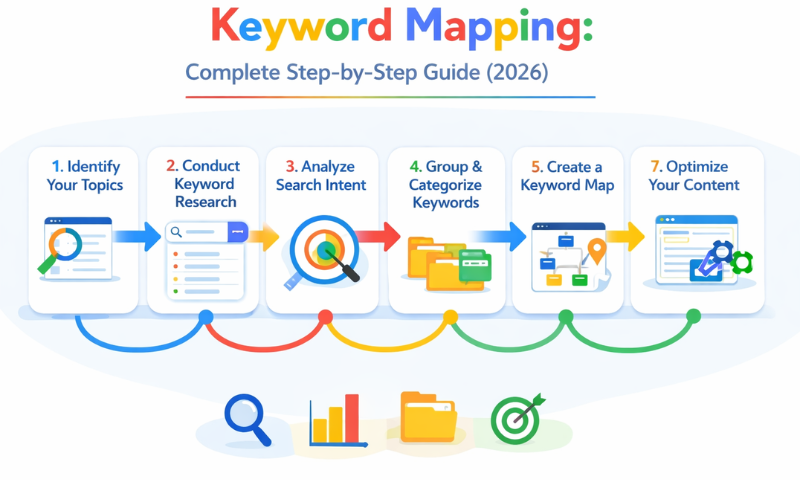
How to Do Keyword Mapping: 6 Steps
01
Audit Your Existing Pages First
Don’t start with keyword research — start with what you already have
Before you touch a keyword research tool, crawl your existing site and list every URL you have. This is the step most guides skip — and it’s the reason most keyword maps fail. If you don’t know what pages already exist, you’ll create a map full of duplicates.
For each page, record: the URL, the current page title, what keyword it seems to be targeting (even loosely), and roughly how much traffic it gets (use Google Search Console). You’re building the foundation of your map.
🛠️ Tools for this step
Screaming Frog (free up to 500 URLs)
Google Search Console
Sitemap.xml
Ahrefs Site Audit
💡 Pro tip: In Google Search Console, go to Search Results → Pages → sort by Clicks. This shows you which pages already attract traffic — and what queries they rank for. That’s your starting keyword data, before you’ve touched a keyword tool.
02
Build Your Keyword List by Type
Pillar keywords, cluster keywords, and keyword variations
Every keyword in your map belongs to one of three categories. Understanding which is which determines how you build your site structure.
🏛️ Pillar Keywords
Broad, high-volume terms that represent your main topics. These go on your most comprehensive, in-depth pages.
Example: “SEO services”, “content marketing”, “link building”
🌿 Cluster Keywords
More specific subtopics that relate to a pillar page. Each cluster keyword gets its own dedicated page, which links back to the pillar.
Example: “on-page SEO checklist”, “title tag best practices”
🔀 Keyword Variations
Synonyms, related terms, and alternate phrasings of your primary keyword. These go on the same page as the primary — not on separate pages.
Example: “SEO optimisation”, “search engine optimisation”
⚠️ Critical rule: Keyword variations go on the same page as the primary keyword. Cluster keywords get their own page. Getting this wrong is the most common cause of keyword cannibalization.
03
Analyse Search Intent for Every Keyword
The most skipped step — and the most important
Search intent is the reason behind a search query. Google’s algorithm is trained to match content type to intent — which means if your content format doesn’t match the intent, you won’t rank no matter how well optimised the page is.
| Intent Type |
What They Want |
Best Content Type |
Example Keywords |
| 📚 Informational |
Learn something |
Blog post, guide, how-to |
“what is keyword mapping”, “how to do SEO” |
| 🛒 Commercial |
Compare options before buying |
Comparison, review, best-of list |
“best SEO tools”, “Ahrefs vs Semrush” |
| 💳 Transactional |
Buy or take action now |
Service page, product page, landing page |
“hire SEO agency”, “buy backlinks” |
| 🧭 Navigational |
Find a specific site/brand |
Homepage, brand page |
“Rankosys SEO agency”, “Ahrefs login” |
💡 How to verify intent manually: Google the keyword and look at the top 5 results. If they’re all blog posts, your page needs to be a blog post. If they’re all product pages, build a product page. Google has already done the intent research — follow what’s ranking.
04
Assign Keywords to Pages (One Primary Per Page)
The core rule of keyword mapping
This is where keyword mapping actually happens. You’re assigning one primary keyword to each page — the keyword that page is primarily trying to rank for. No page shares a primary keyword with another page. That’s the rule.
❌ Cannibalization Example — What to Avoid
Page 1: /seo-tips → targeting “SEO tips”
Page 2: /seo-guide → targeting “SEO tips” (SAME KEYWORD)
Page 3: /beginners-seo → targeting “SEO tips for beginners”
Pages 1 and 2 are cannibalising each other. Google will rank neither page as highly as it would rank one consolidated page.
✅ Fixed — Clean Keyword Map
Page 1: /seo-guide → targeting “SEO tips” (primary) + “SEO basics” (variation)
Page 2: /seo-tips-beginners → targeting “SEO tips for beginners” (own keyword)
Page 3: /advanced-seo → targeting “advanced SEO techniques” (own keyword)
05
Build Internal Links Based on Your Map
The step that turns a keyword map into ranking power
Your keyword map is a blueprint for your internal linking structure. Every cluster page should link to its pillar page using keyword-rich anchor text. The pillar page should link back to key cluster pages. This creates topic clusters that pass authority both ways.
🔗 Internal Linking Rules from Your Keyword Map
1
Link from cluster page → pillar page using the pillar page’s primary keyword as anchor text
2
Link from pillar page → cluster pages using the cluster page’s primary keyword as anchor text
3
Never use the same anchor text to link to two different pages — this creates internal cannibalization
4
High-priority pages (commercial/transactional intent) should receive the most internal links from across the site
06
Track Status and Update Your Map Regularly
A keyword map is a living document — not a one-time task
A keyword map that you build once and ignore becomes outdated quickly. Algorithms change. New keywords emerge. Old content goes stale. Your map needs a status column and a regular review cadence.
📝
To Create
Keyword mapped, page not yet built
⚠️
To Optimise
Page exists but needs keyword work
✅
Live & Optimised
Page live, keywords fully mapped
🔄
Needs Update
Content outdated, refresh required
✅ Review cadence: Check your keyword map quarterly. After each content update, mark the status and record the date in a “Last Updated” column. This turns your keyword map into a content audit tool as well.
⚔️
How to Find & Fix Keyword Cannibalization
Keyword cannibalization happens when two or more pages on your site compete for the same keyword. Google can’t decide which one to rank, so it often ranks neither — or ranks the wrong one. Here’s how to find and fix it.
🔍 3 Ways to Find Cannibalization
Method 1 — Google Site Search
Search site:yoursite.com "your keyword" in Google. If multiple pages appear, you likely have cannibalization.
Method 2 — Google Search Console
Filter by a keyword in the Performance report. If multiple URLs appear with impressions for the same query — that’s cannibalization.
Method 3 — Ahrefs / Semrush
Use the “cannibalization” report in Ahrefs Site Audit or the Position Tracking tool in Semrush to see keywords ranking on multiple URLs simultaneously.
| Situation |
Fix |
How |
| Two very similar pages on same topic |
Merge |
Combine content into one strong page, 301 redirect the weaker URL |
| Pages are genuinely different but rank for same keyword |
Differentiate |
Rewrite each page to target different, more specific keywords. Assign them in your keyword map. |
| One page clearly stronger (traffic, links) |
Consolidate |
Add canonical tag on weaker page pointing to stronger, or 301 redirect |
| Weak page with no traffic, no links |
Delete + 301 |
Delete the thin page and 301 redirect it to the best matching page on the site |
🏢
Keyword Mapping by Site Type
Keyword mapping looks different depending on what type of site you’re running. Here’s how to adapt the process for the three most common site types:
Focus on informational keywords organised around topic clusters. Each pillar page is a comprehensive guide. Cluster posts cover specific sub-questions within that topic.
Pillar: “SEO strategy”
Cluster: “how to do keyword research”
Cluster: “on-page SEO checklist”
Cluster: “SEO title tag guide”
Map transactional keywords to product/category pages and informational keywords to blog content. Never target “buy running shoes” on a blog post or “best running shoes guide” on a product page.
Category: “men’s running shoes”
Product: “Nike Air Zoom Pegasus”
Blog: “how to choose running shoes”
🏢
Service Business / Agency
Map commercial/transactional keywords to service pages. Support them with informational blog content that captures research-phase traffic and internally links to service pages.
Service: “SEO agency London”
Service: “technical SEO audit”
Blog: “what is technical SEO”
Blog: “SEO ROI statistics”
🛠️
Best Tools for Keyword Mapping in 2026
| Tool |
Best For |
Free? |
Standout Feature |
| Google Search Console |
Mapping existing pages to their current keywords |
Free |
Shows real queries your pages already rank for |
| Ahrefs |
Keyword research, gap analysis, cannibalization detection |
Paid |
Keyword clustering + site structure visualiser |
| Semrush |
Topic clusters, Keyword Strategy Builder |
Freemium |
Keyword Strategy Builder auto-builds topic clusters |
| Screaming Frog |
Auditing existing pages before mapping |
Free (500 URLs) |
Crawls your entire site and exports URL list in seconds |
| Google Sheets |
Building and maintaining your keyword map |
Free |
Shareable, collaborative, no cost — the standard tool |
| Surfer SEO |
On-page optimisation after mapping |
Paid |
Content editor scores pages against SERP competitors |
⚠️
5 Keyword Mapping Mistakes That Kill Rankings
1. Assigning the same keyword to multiple pages
The classic cannibalization mistake. One primary keyword per page — no exceptions. If you have two pages that both want to rank for “SEO tips”, merge them.
2. Ignoring search intent when mapping
Mapping “buy SEO services” to a blog post will never rank. Intent and content type must match. Always check the SERPs before assigning a keyword to a page type.
3. Treating keyword variations as separate target keywords
“SEO tips” and “SEO advice” are variations, not different keywords. Creating separate pages for each is thin content creation that dilutes your authority.
4. Building the map but not maintaining it
A keyword map is a living document. Rankings shift. New keywords emerge. If you don’t review your map quarterly, it becomes a roadblock rather than a guide.
5. Mapping keywords without checking topical authority gaps
If you try to rank a cluster post without having a pillar page in that topic area, Google has no reason to trust your authority on the subject. Build the pillar first, then the clusters.
❓
Frequently Asked Questions
How many keywords should I map to one page?
One primary keyword per page — no exceptions. You can (and should) include multiple secondary keywords and variations on the same page, but only one keyword is the primary target. Secondary keywords should be semantically related and should appear naturally throughout the content rather than being forced in.
What is the difference between keyword mapping and keyword research?
Keyword research is the process of finding keywords. Keyword mapping is the process of assigning those keywords to specific pages on your website. Research comes first — mapping comes after. Think of research as building the ingredient list and mapping as writing the recipe.
How often should I update my keyword map?
Review your keyword map quarterly at minimum. Update it whenever you publish new content, redirect or delete a page, merge two pages, or notice a significant ranking drop in Search Console. The map is never “finished” — it evolves with your site.
What is keyword cannibalization and how does keyword mapping fix it?
Keyword cannibalization is when two or more pages on your site compete for the same keyword. Google becomes confused about which page to rank and often promotes the wrong one — or neither. Keyword mapping prevents this by ensuring each keyword is assigned to exactly one page before content is created, so two pages never target the same term.
Do I need a keyword map for a small website?
Yes — especially for small websites. When you have fewer pages, every page needs to work harder. A keyword map ensures you’re not wasting any page on a keyword that doesn’t drive traffic, and that there’s no overlap between your limited number of pages. A 10-page site with a clean keyword map will consistently outperform a 10-page site without one.
What is a keyword mapping template and do I need one?
A keyword mapping template is a pre-built spreadsheet with columns for URL, primary keyword, secondary keywords, search volume, keyword difficulty, intent, status, and last updated date. You don’t need a special template — Google Sheets works perfectly. The key is consistency: whatever columns you choose, use them the same way across every row in the map.
🗺️
Need Help Building Your Keyword Map?
Keyword mapping is one of the highest-ROI SEO activities available — but it takes time to do properly. At Rankosys, we build complete keyword maps as part of our SEO strategy service, including cannibalization audits, topic cluster architecture, and full implementation.
Get a Free SEO Audit →