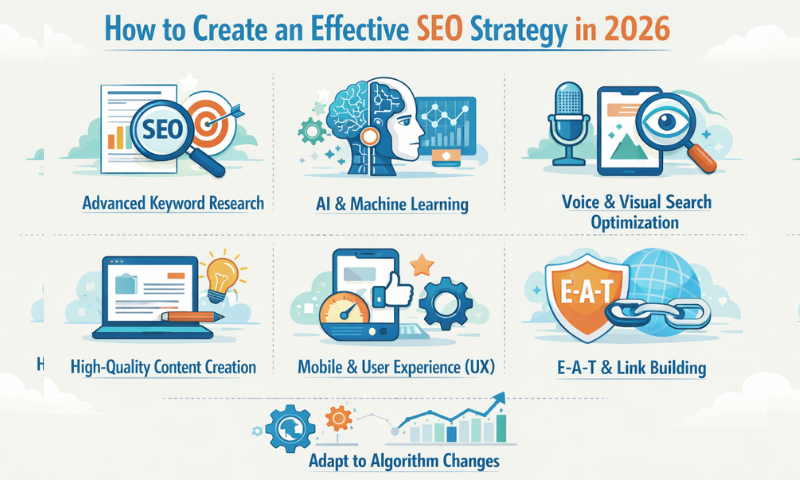
How do you create an effective SEO strategy in 2026? An effective SEO strategy in 2026 follows eight steps: (1) Define business goals — not just rankings, (2) Research topics using customer intelligence, competitors, and multiple platforms, (3) Analyse search intent before writing a word, (4) Fix your technical foundation — speed, crawlability, mobile, (5) Create authority-driven content that genuinely helps people, (6) Optimise for AI citation visibility (AEO/GEO), (7) Build links and earn brand mentions, (8) Update and improve what you already have. The teams that win are not chasing tactics. They are building clarity, authority, and relevance across every place people search for answers.
✓ 8 Actionable Steps
✓ SEO + AEO + GEO
✓ Tools Comparison
✓ Timeline + KPIs
SEO has changed. Search is no longer just a list of blue links. It is answers, summaries, AI-generated responses, and recommendations coming from Google, ChatGPT, Perplexity, Reddit, and YouTube simultaneously. The fundamentals still matter — but the bar is higher, the landscape is more crowded, and a strategy built purely around keyword rankings is no longer enough.
This is a practical, step-by-step guide to building an SEO strategy that works in 2026 — one that drives real business results, not just traffic numbers. Whether you are starting from scratch or auditing an existing strategy, every step here is actionable, sequenced, and explained in plain language.
Define Your SEO Goals — Start With Business Outcomes, Not Rankings
The most common SEO mistake is chasing rankings and traffic instead of revenue. Rankings and traffic are inputs — what matters is whether SEO is driving qualified leads, reducing your customer acquisition cost, or increasing brand awareness in your target market. If you cannot connect your SEO activity to a business outcome, you will always struggle to justify the investment.
Ask yourself one question before doing anything else: What would make SEO a clear win for my business this year? The answer should be a business outcome — not an SEO metric.
| Business Type | Meaningful SEO Goal | Right Metric to Track |
|---|---|---|
| Agency / Service Business | 200 qualified enquiries/month from bottom-funnel keywords | Qualified leads, cost per acquisition |
| E-commerce Brand | 30% increase in organic revenue from product pages | Organic revenue, conversion rate |
| Local Business | 50 new customers/month from “[service] near me” searches | Store visits, local leads, direction requests |
| SaaS / Software | 200 qualified demo requests from problem-aware keywords | Demo requests, trial signups, CAC from organic |
| Content / Affiliate Site | £10k monthly revenue from buying-intent comparison content | Affiliate revenue, organic traffic to money pages |
Research Topics Across Every Platform Your Customers Use
Keyword research in 2026 is not just about running a tool and exporting a list. Your customers are searching everywhere — Google, YouTube, Reddit, TikTok, ChatGPT, and in community forums. A single-platform approach misses most of the picture. Here is how to build a topic list that reflects real demand.
Step 1: Mine Your Own Customer Data First
Before you open a single keyword tool, you have access to intelligence your competitors do not: direct customer insights. The language your customers use when describing their problems is almost always more valuable than what a keyword tool suggests — because it reflects intent, not just search volume.
- ✓Read every support ticket, client email, and sales call transcript from the past 6 months — underline the exact phrases customers use
- ✓Check your Google Search Console — the “Queries” report shows you what real people typed before finding your site
- ✓Read your own Google reviews and competitor reviews on Google, Trustpilot, and industry review sites — note recurring complaints and praise
- ✓Browse relevant subreddits and Quora threads — pay attention to questions that get high engagement and the exact language used
Step 2: Reverse-Engineer Your Competitors’ Best Content
Your competitors have already spent months — sometimes years — finding the topics that drive business results. Do not ignore that intelligence. Spend 30 minutes finding their highest-traffic pages and the commercial intent behind them. This single activity often reveals 3–6 months of high-impact content opportunities.
How to find competitor content gaps with Semrush or Ahrefs
Step 3: Validate and Expand Across Platforms
Prioritise Keywords — Not All Traffic Is Equal
Most SEO guides skip this step entirely — they go straight from keyword research to content creation without ever deciding which keywords to prioritise first. This is why so many SEO strategies produce a lot of content that ranks for things that do not actually matter to the business.
Every keyword should be scored across three dimensions before you commit any resource to it:
Analyse Search Intent — Before You Write a Single Word
Search intent is the “why” behind a search query. It is the most important thing to get right before you create any content — because Google’s job is to match content to intent, and if your content format does not match what the searcher is actually looking for, it will not rank regardless of how well-written it is.
How to decode intent in 5 minutes: Search your target keyword in Google and study the first page results. The results tell you exactly what Google has concluded users want.
| What to Look For | What It Tells You | Action |
|---|---|---|
| Mostly listicles | Users want options, not one answer | Create a list post |
| Mostly step-by-step guides | Users want to learn how to do something | Create a how-to guide |
| Product / service pages | Users are ready to buy or compare | Optimise your product/service page |
| Tool pages dominate | Users want something to use, not read | Build a free tool or resource |
| Videos + Reddit threads | Users want personal experiences and visual demos | Create video content and community presence |
Featured snippets show exactly what Google considers the “best” answer for the query — that is your target format. People Also Ask boxes reveal related questions you must address in your content. Both are also direct AEO targets: if you win the featured snippet, you are likely to be cited in AI-generated answers for the same query.
Step 5: Fix Your Technical Foundation (What Backlinko Skips)
Most SEO strategy guides — including most top-ranked ones — barely mention technical SEO. That is a significant gap because no content strategy works if Google cannot crawl and index your pages. Technical SEO is the foundation everything else is built on. You do not need to be a developer to fix the most common issues, but you do need to know they exist.
| Technical Issue | Impact on SEO | Priority | How to Check |
|---|---|---|---|
| Pages blocked by robots.txt | Google cannot crawl or index — content is invisible | 🔴 Critical | GSC URL Inspection |
| Slow LCP (over 4 seconds) | Direct ranking factor — hurts rankings and user experience | 🔴 Critical | PageSpeed Insights |
| No HTTPS (HTTP pages) | Trust signal failure — Chrome shows “Not Secure” warning | 🔴 Critical | SSL Labs |
| Broken internal links (404s) | Wastes crawl budget, loses link equity | 🟡 High | Screaming Frog |
| Poor mobile usability | Google mobile-first index — poor mobile = poor rankings | 🟡 High | GSC Mobile Report |
| Missing schema markup | Misses rich results + reduces AI citation probability | 🟢 Important | Rich Results Test |
Create Authority-Driven Content That Actually Helps People
Content creation in 2026 is not about volume — it is about authority. Google’s AI and human Quality Raters are specifically trained to identify whether content was written by someone with genuine experience and expertise, or assembled from other sources by someone who has never actually done the thing they are writing about. The difference is obvious, and it increasingly affects rankings.
AI assists your experience — it does not replace it
Use AI for outlines, first drafts, finding supporting examples, and organising complex information. But the experience, the case studies, the first-hand insights, and the voice — those must be yours. Google and AI platforms are specifically designed to identify and reward content that reflects genuine human experience. The sites winning in 2026 are not publishing AI content — they are using AI to work faster while publishing human content.
Optimise for AI Visibility — The Step Most SEO Strategies Skip
In 2026, an SEO strategy that only targets Google rankings is incomplete. Over 50% of informational queries are answered directly by AI platforms — ChatGPT, Perplexity, Google AI Overviews, Bing Copilot — without a click ever happening. If your content is not optimised to be cited by these platforms, you are invisible to a growing share of your audience.
- ✓Allow AI crawlers in your robots.txt (GPTBot, PerplexityBot, ClaudeBot)
- ✓Write direct answers in the first 2–3 sentences of each section
- ✓Use question-based H2/H3 headings aligned to real search queries
- ✓Add FAQ sections to all informational and service pages
- ✓Implement FAQPage and Article schema markup across your site
- →Go to Perplexity AI and ask the questions your customers ask
- →Check if your site is cited in the sources — if competitors are cited and you are not, that is your gap
- →Check Google Analytics for referral traffic from perplexity.ai and chatgpt.com
- →Test target keywords in Google to see if you appear in AI Overviews
Build Links and Earn Brand Citations
Links are still one of the strongest ranking signals in Google’s algorithm. But the goal has changed in 2026. It is not just about passing PageRank — it is about influencing how search engines and AI platforms understand your brand. Think less like an SEO and more like a PR professional. Your goal is comprehensive visibility across the web: backlinks, forum mentions, expert quotes, and citations that AI platforms reference.
| Link Building Tactic | How It Works | Difficulty | AI Citation Impact |
|---|---|---|---|
| Original data / research | Publish statistics, surveys, or studies others cite | Medium | ★ Very High |
| Competitor link analysis | Find who links to competitors, reach out with something better | Low–Medium | ✓ Medium |
| Expert commentary (HARO) | Respond to journalist requests for expert quotes | Low | ★ High |
| Community participation | Genuine contributions on Reddit, Quora, industry forums | Low | ★ High (LLM seeding) |
| Digital PR / press features | Earn features in industry publications and media | High | ★ Very High |
Update and Improve — Your Best Content Is Already Published
Most businesses focus almost all their SEO effort on creating new content. They publish, they move on. But here is the reality: updating existing content almost always delivers faster ROI than writing from scratch. Your existing ranked pages already have authority, backlinks, and indexation history. A meaningful update to a declining article is often faster than creating a new one that needs to build all of that from zero.
If you have two similar pages targeting adjacent keywords, merging them into one comprehensive resource often outperforms both. Consolidation combines the ranking signals, backlinks, and authority of both pages into a single, stronger asset — and eliminates the keyword cannibalisation that was likely holding both back.
How to Measure Your SEO Strategy (KPIs That Actually Matter)
Measuring SEO in 2026 is harder than it used to be. Zero-click searches, AI-answered queries, and privacy-driven tracking reduction mean you will never have perfect attribution. That is OK. Focus on directional trends and leading indicators — not perfect numbers.
| Metric | What It Tells You | Where to Track | Review |
|---|---|---|---|
| Organic traffic to commercial pages | Are money pages getting organic visitors? | Google Analytics 4 | Monthly |
| Qualified leads / conversions from organic | Is SEO traffic converting to business outcomes? | GA4 Goal completions | Monthly |
| Branded search volume | Is SEO building brand awareness and demand? | Google Search Console | Monthly |
| AI referral traffic (Perplexity, ChatGPT) | Are AI platforms citing and sending traffic? | GA4 Referral sources | Monthly |
| Rankings for target commercial keywords | Are business-critical pages moving up? | Semrush / Ahrefs / GSC | Weekly |
| Share of voice vs competitors | Are you gaining or losing ground? | Semrush Keyword Tracking | Monthly |
Realistic SEO Timeline: What to Expect and When
One of the most common reasons SEO strategies get abandoned is unrealistic expectations. Here is an honest timeline for what to expect at each stage:
| Timeframe | What to Focus On | Realistic Results |
|---|---|---|
| Month 1 | Technical audit + fix critical issues, keyword research, goal setting | Improved crawlability, indexing of blocked pages |
| Months 2–3 | First content pieces published, schema implementation, on-page optimisation | Initial indexing of new content, early ranking signals |
| Months 3–6 | Content cluster building, link building starts, content updates | Early rankings for long-tail keywords, some featured snippets |
| Months 6–12 | Scale content production, compound link building, update existing content | Measurable traffic growth, commercial keyword movement, organic leads |
| 12+ Months | Maintain, optimise, and compound — content updates, new clusters, authority building | Strong rankings, compounding organic traffic, AI citation visibility |
Frequently Asked Questions
Rankosys builds SEO strategies that cover all three layers: traditional search rankings, AI citation visibility, and brand authority. We start with your business goals — not generic keyword lists — and build a plan tailored to your industry, competitors, and growth targets. No contracts. No fake promises. Real, measurable results.