AI content optimization is the practice of using artificial intelligence tools to analyze, improve, and scale your content—boosting both traditional search rankings and AI-generated answer visibility (AEO/GEO).
⚡ AEO Impact: High
🤖 AI-Era Essential
AI is no longer just a writing assistant — it’s become the backbone of competitive content strategies. From identifying content gaps to earning citations in ChatGPT and Perplexity, AI content optimization is now a core discipline every SEO must master. This guide covers 8 proven techniques, the best AI tools, and a complete optimization checklist you can act on today.
What Is AI Content Optimization? (And Why It Matters Now)
The content landscape has fundamentally shifted. In 2026, Google processes over 13 billion searches daily, while AI tools like ChatGPT, Gemini, and Perplexity now handle hundreds of millions of queries. Your content doesn’t just need to rank in blue links—it needs to earn citations from AI systems that aggregate answers.
AI content optimization sits at the intersection of traditional SEO and Answer Engine Optimization (AEO). It leverages machine learning tools to audit your existing content, spot gaps competitors are exploiting, improve topical authority, and restructure content so AI models can extract and cite it accurately.
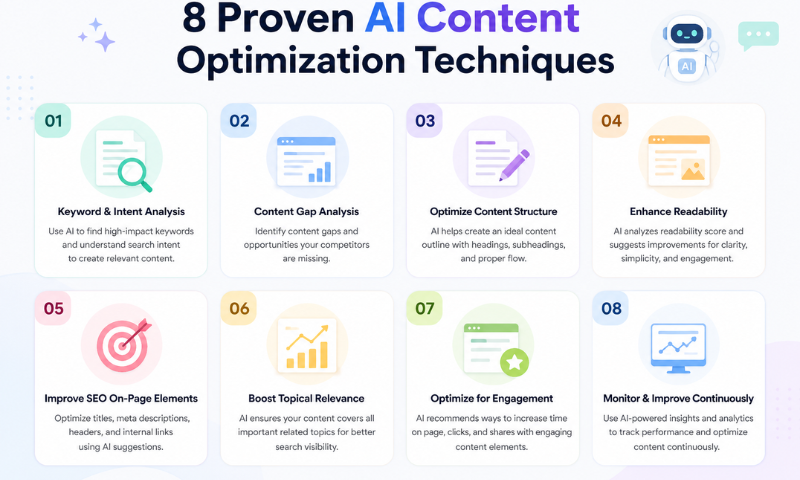
8 Proven AI Content Optimization Techniques
AI audit tools scan your entire site and flag structural weaknesses — missing meta descriptions, thin content, poor internal linking, and keyword cannibalization — faster than any manual review. Tools like Semrush’s On-Page SEO Checker, Surfer SEO, and Clearscope process hundreds of pages in minutes, returning prioritized action lists.
AI tools like ChatGPT, Perplexity, and Google’s AI Overviews pull answers from well-structured, authoritative content. To earn citations, your content needs direct answer formats: concise definitions, numbered lists, comparison tables, and FAQ sections. Semrush’s AI Visibility Toolkit maps which prompts your content should target based on search intent clusters.
Modern search engines don’t just match keywords; they understand topics. AI tools like Keyword Insights, MarketMuse, and Semrush’s Topic Research cluster related terms into semantic groups so you build genuine topical authority rather than chasing individual keywords. A single well-clustered pillar page can outrank dozens of thin keyword-targeted posts.
Google’s Helpful Content system rewards content that demonstrates genuine expertise and satisfies user intent. AI editing tools like Hemingway, Grammarly Business, and ChatGPT can restructure dense paragraphs, flag passive voice, improve sentence variety, and align tone to your target audience — all within minutes. Lower reading level = higher engagement = better rankings.
The biggest bottleneck for most SEO strategies isn’t strategy — it’s production. AI tools accelerate every stage: research (Perplexity), outlining (ChatGPT), drafting (Claude), editing (Grammarly), and image selection (Midjourney/Adobe Firefly). A skilled content team using AI can produce 3× more high-quality articles at the same cost. The key is using AI for first drafts, then adding genuine human expertise and original data.
Studies show that 70% of a website’s SEO value often comes from just 20% of its content — and that content decays over time as it falls out of date. AI tools like Semrush’s Content Audit, MarketMuse, and BrightEdge identify which pages are losing rankings and recommend specific updates: new stats, updated sections, added subheadings, or expanded keyword coverage.
Featured snippets appear for 12.3% of all queries — and 99% of featured snippets come from pages already in the top 10. AI tools can identify snippet opportunities where a competitor holds the snippet with weaker content than yours. The fix: add a concise 40–60 word definition immediately after the question/header, or use a structured table, numbered list, or step-by-step format.
Structured data helps both traditional search engines and AI systems understand your content’s context. Schema markup for articles, FAQs, how-to guides, reviews, and local businesses significantly increases the chance of rich result appearances — which earn 20–30% higher CTRs than standard blue links. AI-powered tools like Schema App, RankRanger, and Google’s own Structured Data Markup Helper generate accurate JSON-LD in seconds.
Best AI Content Optimization Tools (2026 Comparison)
The brands winning in AI search right now aren’t just producing more content — they’re producing structured, citable content. Our AI-powered SEO approach combines semantic clustering, AEO structuring, and quarterly content refreshes to build compounding topical authority. The result: clients typically see 40–60% organic traffic growth within 6 months.
AI Content Optimization Checklist
- ✓ Run AI content audit on top 20 pages monthly
- ✓ Add Quick Answer box to every article (40–60 words)
- ✓ Build topic clusters with pillar + 6–10 supporting pages
- ✓ Optimize for Flesch-Kincaid Grade 7–9 readability
- ✓ Set quarterly refresh schedule for posts ranked #5–20
- ✓ Target featured snippet gaps with structured answer formats
- ✓ Implement FAQ schema on every blog post
- ✓ Monitor AI search citation rate monthly via Perplexity + ChatGPT brand tracking
Frequently Asked Questions
Google doesn’t penalize AI-generated content — it penalizes low-quality, unhelpful content regardless of how it was made. Accurate AI content, well-structured, demonstrates expertise, and genuinely helps users perform just as well as human-written content. The key is always human review, original insights, and E-E-A-T signals.
Build topical authority through consistent, comprehensive coverage of your niche. AI tools favor sources that: appear in multiple authoritative backlink profiles, have structured data, provide direct answers to common questions, and are regularly updated. Earning mentions in industry publications that AI tools frequently cite also boosts citation likelihood.
A baseline AI content optimization stack costs $200–$400/month in tool subscriptions (Semrush + Surfer SEO). Full-service AI-powered SEO packages from agencies like Rankosys start at $199/month and include audit, content strategy, production, and monthly reporting — significantly cheaper than managing the toolstack in-house.
Rankosys builds AI-powered content strategies that rank in Google and get cited by ChatGPT, Perplexity, and Google AI Overviews.