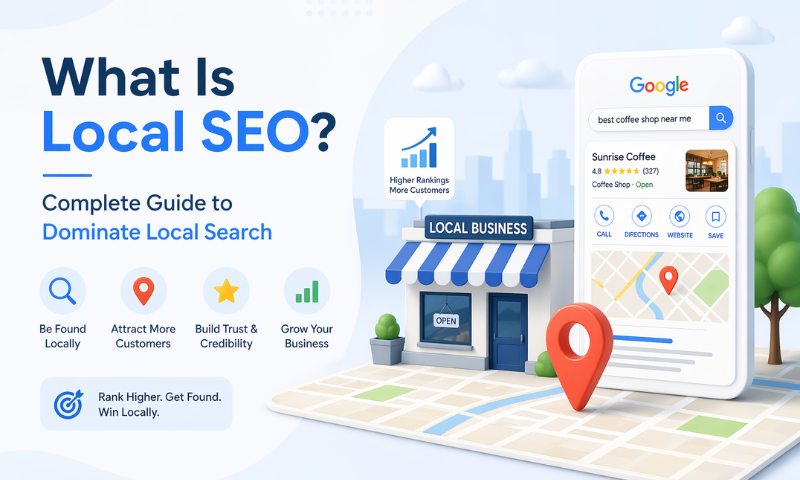
What is Local SEO?
Local SEO is the process of optimizing your online presence to rank higher in location-based searches on Google Search, Google Maps, and AI answer engines — so nearby customers find and choose your business first.
🤖 AEO Optimized
⚠️ High Competition Keyword
Every month, billions of searches include local intent — “near me,” city names, neighborhood queries. Yet most small businesses have no idea they’re invisible in 90% of them. If you run a law firm in Austin, a roofing company in Chicago, or a dental clinic in Miami — local SEO is the single highest-ROI strategy you can invest in. This guide explains exactly what it is, how Google’s local algorithm works, and the proven step-by-step system to rank in the local pack, Google Maps, and AI answer engines like ChatGPT and Perplexity.
What Is Local SEO? (Plain English Definition)
Local SEO (Local Search Engine Optimization) is the practice of improving your business’s visibility in geographically targeted search results. Unlike traditional SEO, which targets broad national or global audiences, local SEO focuses on connecting your business with people searching for your product or service in your city, neighborhood, or service area.
When someone Googles “best plumber in Denver” or “emergency dentist near me,” Google shows a Local Pack (the map with 3 business listings) before organic results. That Local Pack is prime real estate. Local SEO is how you win it.
How Local SEO Works: Google’s 3 Ranking Signals
Google uses a separate local algorithm for Map Pack rankings. Unlike traditional SEO, it doesn’t just care about content quality — it weighs three core signals:
💡 Action Tip
Local SEO differs from standard SEO in a key way: a brand-new site with zero backlinks can outrank an established site if it has better GBP optimization, more reviews, and consistent NAP citations.
Local Keyword Research: Finding Terms That Drive Foot Traffic
Local keyword research means finding the exact phrases your target customers type when they need your service in your city. These keywords typically follow predictable patterns:
3 proven methods to find local keywords:
Type your service + city into Google and capture every suggestion. Try variations: “electrician in [city]”, “best electrician [city]”, “[city] electrician reviews”. These are real searches from real people — zero guesswork.
Look at the top 3 businesses in the local pack for your target keyword. Analyze what categories they’ve selected in their GBP, what keywords appear in their business description, and what services they list. Those are clues to ranking signals.
Free tool inside Google Ads. Filter search volume by specific city or metro area to discover demand data your competitors are ignoring. Sort by “Competition: Low” to find quick-win opportunities.
Google Business Profile Optimization (The #1 Local Ranking Factor)
Your Google Business Profile (GBP) is the single most powerful tool in local SEO. It’s free, it can rank within days, and it directly controls what users see when they search for you. Most businesses fill it out poorly — which is your opportunity.
Complete GBP Optimization Checklist:
- ✔ Claim and verify your business profile
- ✔ Choose the most specific primary category (e.g., “Personal Injury Attorney” not just “Lawyer”)
- ✔ Add all secondary categories relevant to your services
- ✔ Write a keyword-rich business description (750 chars max — use them all)
- ✔ Upload 10+ high-quality photos (exterior, interior, team, work samples)
- ✔ Add all services with individual descriptions and prices where applicable
- ✔ Post weekly GBP updates (offers, news, events)
- ✔ Set up Q&A with pre-answered common questions
- ✔ Enable messaging and respond within 24 hours
Real-World Local SEO Example: Plumber in Austin, TX
Here’s how a real local business — let’s call them Austin Fast Plumbing — went from zero local visibility to ranking #1 in the Map Pack for “plumber Austin” in 4 months.
Starting Point
GBP claimed but empty. No reviews. Inconsistent phone number across 3 directories. Website had no city-specific pages.
Actions Taken
Fully optimized GBP. Built 5 location landing pages. Fixed NAP across 40+ directories. Launched a review request campaign — got 38 reviews in 6 weeks.
Results (Month 4)
#1 in Map Pack for “plumber Austin.” 340% increase in GBP calls. 19 new customers/month from organic local search alone.
NAP Citations: The Trust Signals Google Can’t Ignore
NAP stands for Name, Address, Phone Number. Citations are any mention of your NAP data across the web — business directories, industry sites, news articles, social profiles. Google cross-references these to verify your business is real and trustworthy.
Inconsistent NAP is one of the most common (and harmful) local SEO mistakes. If your business is listed as “Austin Fast Plumbing LLC” on Google but “Austin Fast Plbg” on Yelp — that discrepancy hurts your prominence score. Every listing must match exactly.
Top citation sources to get listed on:
Google Business Profile, Bing Places, Apple Maps, Facebook, Yelp, BBB
Avvo (lawyers), Healthgrades (doctors), Houzz (contractors), Zillow (realtors)
Data Axle, Neustar Localeze, Factual — these feed hundreds of smaller directories automatically
Google Reviews: The Local SEO Multiplier Most Businesses Neglect
Reviews influence local rankings and conversion simultaneously — they’re the only signal that does both. More reviews = more prominence. Better ratings = more clicks. Keyword-rich reviews = better relevance matching. Here’s how to systematically generate them:
On-Page Local SEO: Optimizing Your Website for Location Searches
Your website is the second pillar of local SEO. Google needs to confirm your business location and service areas through your site’s content, structure, and technical signals.
Build dedicated pages for each city you serve: /seo-agency-chicago/, /seo-agency-dallas/, etc. Each page needs unique content, local signals, and its own H1 with the city + service keyword.
An embedded Google Map tied to your verified GBP listing sends a strong location signal. Make sure the address in your footer, contact page, and embedded map all match your GBP exactly.
Schema.org structured data tells Google exactly what your business is, where it’s located, what its hours are, and what services it offers. Use the LocalBusiness or more specific schema types (LegalService, HomeAndConstructionBusiness, etc.)
Format: [Service] in [City] | [Business Name] — e.g., “Emergency Plumber in Austin | Austin Fast Plumbing.” Include city name naturally in H1, first paragraph, and at least one H2.
Local SEO in the AI Era: AEO + GEO for Local Businesses
AI tools like ChatGPT, Perplexity, and Google’s AI Overviews are increasingly answering local queries. When someone asks “best SEO agency in Chicago” to an AI, those results come from the same trust signals as local SEO — plus your website’s structured data and clear entity definitions.
- Add an FAQ section with exact “near me” and location-specific questions
- Write a clear “About” page that explicitly states your city, service areas, and specialties
- Implement LocalBusiness schema with
areaServed,geo, andopeningHoursproperties - Get mentioned on local news sites, chamber of commerce pages, and industry associations
- Use natural language answers in your content — AI engines pull conversational, direct answers
Frequently Asked Questions About Local SEO
How long does local SEO take to show results?
Most businesses see measurable improvements in GBP rankings within 30–90 days of implementing the core optimizations (GBP, citations, reviews). Full competitive keyword rankings typically take 3–6 months.
Do I need a physical address to rank in the local pack?
No — service-area businesses (plumbers, electricians, cleaners) can hide their address in GBP and still rank. You define a service area instead. However, businesses with a verified physical address do tend to rank with greater consistency in their immediate area.
What’s the difference between local SEO and regular SEO?
Regular SEO targets broad keywords with no location intent. Local SEO specifically targets people in your service area searching for location-specific queries. Local SEO also focuses heavily on GBP, citations, and reviews — signals that have no equivalent in traditional SEO.
How many Google reviews do I need to rank in the local pack?
It depends on your industry and market. In less competitive niches, 10–15 high-quality reviews may be enough. In major cities for competitive industries (law, dental, HVAC), you may need 50–100+ to compete with established businesses. Velocity matters too — consistent new reviews beat a one-time burst.
Can I do local SEO without a website?
Technically yes — a well-optimized GBP alone can rank in the local pack. But a website dramatically increases your ability to rank for keyword variations, build topical authority, and convert visitors. We recommend at minimum a 5-page website paired with GBP.
🚀 Ready to Dominate Local Search?
Get a Free Local SEO Audit for Your Business
Rankosys audits your GBP, NAP consistency, local citations, and on-page signals — then gives you a prioritized roadmap to outrank competitors in your market.