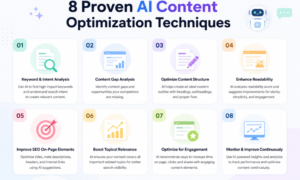
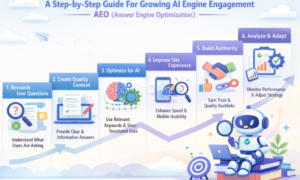
HEO stands for Hybrid Engine Optimization — a unified search framework coined by Jori Ford at SEO Week 2025 that combines traditional SEO, Answer Engine Optimization (AEO), and Generative Engine Optimization (GEO) into one strategy. The goal: ensure your brand ranks on Google while simultaneously getting cited and recommended by AI tools like ChatGPT, Perplexity, and Gemini. Instead of running three separate playbooks, Hybrid Engine Optimization runs all three through one coordinated system.
🤖 SEO + AEO + GEO = HEO
⚡ New Era of Search
🎯 One Framework, All Channels
For nearly two decades, SEO was the entire game. Pick your keywords, build your backlinks, optimize your metadata, and wait for Google to send traffic. That playbook built empires. But in 2026, it’s no longer enough.
Here’s what changed: your audience stopped using only Google. ChatGPT now has 900 million weekly active users. Perplexity processes 780 million queries per month.
Google’s own AI Overviews appear on the majority of commercial and informational searches — and when they do, organic click-through rates drop by as much as 61%. Ranking #1 used to guarantee traffic. Now you can rank first and still be invisible to the growing share of users who get their answer from an AI without ever clicking a link.
The SEO industry responded by spawning a wave of new acronyms: AEO, GEO, LLMO, AIO, SGE optimization. Each one legitimate.
Each one addressing a real problem. And together, they were creating paralysis, marketers asking which strategy to prioritize, agencies billing for three separate frameworks, and businesses unsure where to start.
Hybrid Engine Optimization (HEO) was created to solve that exact problem. One unified framework. One coordinated workflow. Every search channel covered.
This guide explains what HEO is, where it came from, why it represents a genuine new era of search, and exactly how to implement a Hybrid Engine Optimization strategy for your website right now.
What Does HEO Stand For?
HEO stands for Hybrid Engine Optimization. The word “hybrid” is the most important part. It signals that this framework doesn’t choose between traditional search and AI-powered answer engines — it optimizes for both at the same time, through one unified workflow.
As Jori Ford herself put it at SEO Week 2025: “Hybrid just means it doesn’t have to be that hard. We can figure out how to create balance.” That’s the entire philosophy in two sentences. HEO isn’t about adding more complexity — it’s about reducing it by treating all three optimization disciplines as one integrated practice rather than three competing priorities.
Where Did HEO Come From? The Origin Story
Hybrid Engine Optimization was coined by Jori Ford, Chief Marketing and Product Officer at FoodBoss, during her talk titled “Hybrid Engine Optimization: A Crawler Driven Approach to Maximizing Search & AI Visibility” at SEO Week 2025 in New York City.
Traditional SEO dominates. Rankings = traffic. Keyword research, backlinks, and on-page optimization are the entire playbook. Google processes 90%+ of all searches. The formula is simple and it works.
ChatGPT launches. Google rolls out AI Overviews. Perplexity grows rapidly. The industry responds with new acronyms: AEO, GEO, LLMO, AIO, SGE optimization. Each one valid. Each one separate. Marketers are overwhelmed — three new strategies, no unified framework.
Jori Ford presents the Hybrid Engine Optimization framework at SEO Week 2025. Her message: stop running separate strategies. Unify them. Focus on crawl logs as your truth source. Build content that serves search engines and AI systems simultaneously. The concept spreads rapidly across the SEO community.
Hybrid Engine Optimization becomes the working framework for modern search marketing. Agencies, consultants, and in-house teams begin adopting the unified approach. It’s no longer about ranking — it’s about presence across every search surface your audience uses.
The New Era of Search: Why Traditional SEO Is No Longer Enough
To understand why Hybrid Engine Optimization matters, you need to understand what the search landscape actually looks like in 2026, and how dramatically it’s shifted from even two years ago.
The data makes the case plainly. In 2026, your audience is distributed across multiple search surfaces — and a traditional SEO strategy only captures one of them. HEO is the framework that covers the full map.
HEO vs SEO vs AEO vs GEO — What’s the Real Difference?
One of the most common questions about Hybrid Engine Optimization is how it differs from the individual frameworks it incorporates. The answer is both simple and important: HEO doesn’t replace any of them — it orchestrates all of them.
The 7 Pillars of Hybrid Engine Optimization
A complete Hybrid Engine Optimization strategy is built on seven interdependent pillars. Each one serves both traditional search and AI discovery — which is the defining characteristic of HEO: every tactic works across multiple channels simultaneously.
This was Jori Ford’s most radical HEO insight: your server crawl logs are the only source of ground truth about what’s actually happening with search bots. They show which bots (GPTBot, ClaudeBot, PerplexityBot, Googlebot) are visiting your site, which pages they prioritize, and how frequently they return. This is data no tool can give you — only your logs can.
GPTBot → ChatGPT’s crawler
ClaudeBot → Anthropic/Claude’s crawler
PerplexityBot → Perplexity’s crawler
GoogleOther → Google AI Overview crawler
Googlebot → Traditional Google ranking crawler
Everything in Hybrid Engine Optimization starts with a crawlable, fast, mobile-optimized website. If Googlebot can’t crawl your pages efficiently, neither can GPTBot. Core Web Vitals, proper robots.txt, clean sitemap, HTTPS, and no duplicate content — these aren’t optional extras in HEO. They’re the prerequisite for everything else working.
AI systems extract answers — they don’t browse like humans. HEO content is structured to be extractable: direct answer blocks at the top of each page, clear H2/H3 headers that mirror conversational questions, FAQ sections with 40–80 word answers, comparison tables, numbered steps, and definition blocks. This structure serves both Google’s featured snippet algorithm and every AI tool’s extraction system.
Example: A dental practice publishing a page on Invisalign should not open with a paragraph about their history. It should open with: “What is Invisalign? Invisalign is a clear aligner treatment that straightens teeth over 12–18 months using a series of custom-made transparent trays, with no metal brackets or wires.” That’s what AI tools extract and cite.
Schema markup is the machine-readable layer that confirms to both Google and AI crawlers exactly what your content is about. In Hybrid Engine Optimization, schema is not optional — it’s the bridge between your content and every AI system that processes it. FAQPage schema feeds AI Overview directly. Article schema signals content type. LocalBusiness schema feeds location-aware AI recommendations. Product schema powers shopping-intent AI answers.
AI tools don’t cite just any website — they cite sources they’ve learned to trust. Building that trust requires the same signals that build Google E-E-A-T: expert authorship with visible credentials, comprehensive topic coverage through cluster content architecture, consistent publication on a defined subject area, and backlinks from authoritative sources. A website that thoroughly covers one topic is far more likely to earn AI citations than one that covers many topics shallowly.
Large language models like GPT-4 and Claude learn from the web. The more your brand is mentioned, cited, and discussed across authoritative web sources — industry directories, review platforms, news coverage, partner sites, social profiles — the more training data AI systems have to associate your brand with your topic. This is the GEO layer of Hybrid Engine Optimization, and it’s what determines whether AI tools recommend you by name when users ask relevant questions.
Traditional SEO measures success in keyword positions. HEO requires a broader measurement framework because success now spans multiple channels. You need to track: organic traffic (Google Search Console), AI citation appearances (manually test key queries in ChatGPT, Perplexity, Gemini monthly), featured snippet wins, AI Overview appearances, and brand mention velocity across the web.
HEO in Practice: 4 Real-World Examples
Abstract frameworks mean nothing without examples. Here’s how Hybrid Engine Optimization looks in practice across four different business types:
How to Optimize for HEO: Your Action Checklist
This is your practical Hybrid Engine Optimization guide — the exact actions to take, in sequence, when implementing HEO for your website:
At Rankosys, we’ve been running what we now call Hybrid Engine Optimization strategies since before the term was coined—combining technical SEO, AEO-structured content, and GEO brand footprint building into one coordinated monthly plan. The results we see consistently: clients who implement all three layers of HEO outperform those running only traditional SEO by 2–3× on total search visibility within 12 months.
The reason is compounding. Every piece of content structured for AEO also strengthens the SEO signals. Every GEO brand mention also builds the backlink and citation profile that traditional SEO rewards. HEO isn’t just three strategies — it’s a system where each layer amplifies the other two.
Frequently Asked Questions About HEO
No. Hybrid Engine Optimization expands traditional SEO — it doesn’t replace it. Every SEO technique that worked before still applies and still matters: keyword research, on-page optimization, technical SEO, link building. HEO adds the AEO and GEO layers on top of that foundation. As Jori Ford emphasized at SEO Week 2025: “The key distinction is that HEO does not replace SEO. It expands it.”
HEO was coined by Jori Ford, Chief Marketing and Product Officer at FoodBoss, during her talk at SEO Week 2025 in New York City. Her session was titled “Hybrid Engine Optimization: A Crawler Driven Approach to Maximizing Search & AI Visibility.” Ford chose “hybrid” deliberately to unite the fragmented landscape of SEO, AEO, and GEO into one manageable framework.
AEO (Answer Engine Optimization) and GEO (Generative Engine Optimization) are components of HEO — not alternatives to it. AEO focuses specifically on winning structured answer surfaces (snippets, AI Overviews, voice). GEO focuses on being cited and recommended by AI tools through brand footprint signals. Hybrid Engine Optimization is the framework that runs SEO, AEO, and GEO simultaneously through one unified workflow, eliminating the need to manage them as separate strategies.
Yes — and in many ways, small businesses and local practices benefit most from Hybrid Engine Optimization. Local searches are exactly the queries that trigger AI Overviews and voice search results most frequently. A dental practice or law firm that implements HEO — Local SEO for Map Pack, AEO for treatment/service queries, GEO through Healthgrades/Avvo/Yelp signals — can rapidly outperform larger competitors who are running only traditional SEO.
Technical improvements from the SEO layer typically show within 30–60 days. AEO content restructuring — adding Quick Answer blocks, FAQ schema, and structured headers — often produces featured snippet and AI Overview appearances within 60–90 days. GEO brand footprint takes longer: 3–6 months of consistent brand signal building before AI tools reliably begin citing your brand in relevant queries. HEO is a compounding investment, not a quick fix — the three layers build on each other and accelerate together over time.
Hybrid Engine Optimization Strategy?
Rankosys has been running what Jori Ford now calls HEO since before the term existed — combining SEO, AEO, and GEO into one unified monthly strategy for clients across the US, UK, and globally. Start with a free audit and see exactly where your HEO gaps are.
No contracts. No setup fees. Transparent monthly reporting across all three HEO layers.
From $249/month · US, UK & Global · Full Hybrid Engine Optimization