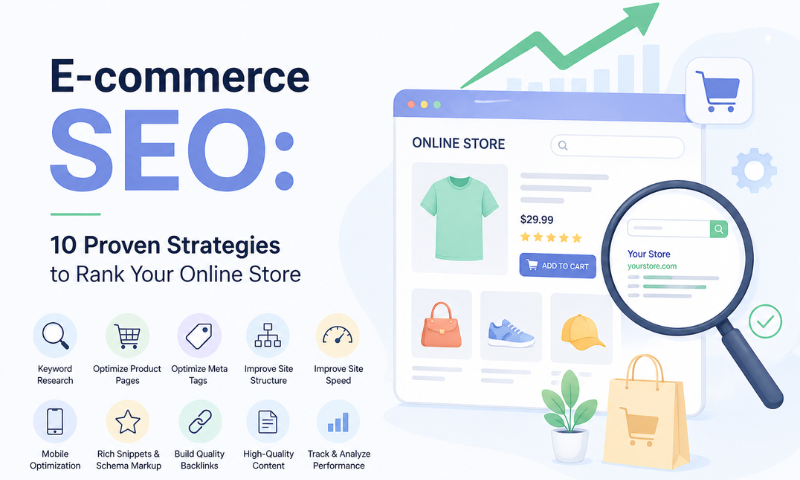
Ecommerce SEO is the process of optimizing an online store’s product pages, category pages, and technical infrastructure to rank higher in search engines — driving free, high-intent organic traffic that converts into customers without paid ad spend.
⚡ Product Schema = Quick Win
🛒 High-Purchase-Intent Traffic
Ecommerce is brutally competitive — but most online stores are leaving enormous amounts of free organic traffic on the table because of easily fixable SEO mistakes. Google drives 43% of all ecommerce traffic, and shoppers who find you through organic search convert at 2–3× the rate of paid ad traffic. This guide covers 10 proven ecommerce SEO strategies that work in 2026 — including platform-specific tactics for Shopify, WooCommerce, and BigCommerce stores.
10 Proven Ecommerce SEO Strategies
Category pages are the highest-traffic, highest-converting pages in any ecommerce store — yet 80% of stores optimize only product pages. Your category page for “Men’s Running Shoes” should target that broad keyword, include 150–300 words of SEO copy above or below the product grid, use H1/H2 headers, internal links to subcategories, and product count signals that help Google understand the page’s authority.
Most ecommerce stores copy manufacturer descriptions verbatim — creating identical content across thousands of competitor sites. Google de-prioritizes duplicate content. Writing unique product descriptions targeting specific buyer keywords (“waterproof hiking boots size 10”, “lightweight carbon fiber road bike”) differentiates your pages and captures long-tail commercial intent that broad keywords miss.
Product schema markup enables Google rich results: star ratings, price, availability, and reviews appearing directly in search results. These enhanced listings generate 20–30% higher CTR than standard results. Product, Review, BreadcrumbList, and FAQ schema are must-haves for ecommerce. Shopify and WooCommerce have plugins that automate this — but they often need manual refinement for accuracy.
Faceted navigation (filtering by color, size, price) creates thousands of URL variants with near-identical content. This wastes crawl budget and dilutes ranking signals. The fix: canonical tags on filtered pages pointing to the base category URL, plus robots.txt disallow rules for parameter combinations that don’t need to rank independently.
Commercial intent keywords (“best running shoes under $100”, “buy gaming chair with lumbar support”) convert at 3–5× the rate of informational queries. Use Ahrefs or Semrush to find these transactional keywords with monthly volume over 100 and difficulty under 40. Create dedicated landing pages or optimized product pages targeting each cluster.
A 1-second delay in page load reduces ecommerce conversions by 7%. Mobile commerce accounts for 60%+ of online shopping in 2026, making Google’s mobile-first indexing more critical than ever. Compress images (use WebP/AVIF), enable lazy loading, minimize CSS/JS, use a CDN, and ensure your above-the-fold content loads in under 1.5 seconds on mobile.
Informational blog content builds topical authority that lifts product and category page rankings. A shoe store that publishes “How to choose running shoes for flat feet” captures top-of-funnel shoppers and links internally to relevant products. Each blog post also earns natural backlinks that organic product pages rarely attract. Aim for 2–4 buyer-intent blog posts per month.
Comparison and roundup articles (“Best Coffee Grinders 2026”, “Top 10 Standing Desks Under $500”) are among the most linked-to content types online. Getting your product featured in these roundups earns high-DA backlinks and referral traffic from engaged buyers. Reach out to bloggers, YouTubers, and review sites with your product + unique angle — an affiliate commission accelerates outreach response rates dramatically.
Google Shopping results appear above both paid ads and organic listings for product queries — making Google Merchant Center an essential traffic channel for ecommerce. Optimizing your product feed with detailed titles, accurate GTINs, high-quality images, and competitive pricing directly impacts both Shopping ads performance and free Google Shopping listings introduced in 2024.
Customer reviews, Q&As, and UGC photos solve two ecommerce SEO challenges simultaneously: they add unique, keyword-rich content to product pages (which Google rewards) and they build social proof that increases conversion rates. Reviews mentioning specific use cases, product features, and comparisons naturally incorporate long-tail keywords you might never have targeted manually.
Ecommerce Platform SEO: Shopify vs WooCommerce vs BigCommerce
Ecommerce SEO Checklist
- ✓ Add 150–200 words of unique SEO copy to top 10 category pages
- ✓ Rewrite product descriptions for top 50 best-sellers (unique, keyword-rich)
- ✓ Implement Product, Review, and BreadcrumbList schema markup
- ✓ Add canonical tags to all faceted navigation / filter URLs
- ✓ Compress all product images to WebP format (use ShortPixel or TinyPNG)
- ✓ Publish 2 buyer-intent blog posts per month with product internal links
- ✓ Set up Google Merchant Center and optimize product feed titles
- ✓ Email post-purchase review request at day 7 with specific prompts
Ecommerce SEO FAQs
Ecommerce SEO typically shows meaningful results in 3–6 months. Technical fixes (speed, canonicals) can improve crawling within weeks. Category page optimization usually moves rankings within 60–90 days. Building topical authority through content compounds over 6–18 months, ultimately reducing your dependence on paid ads.
Shopify is good but not perfect for SEO. It automatically handles sitemaps, canonicals, and basic schema. Its limitations: /collections/ and /products/ URL structures can’t be customized, blog SEO is basic, and some apps add excessive JavaScript that slows performance. For serious ecommerce SEO, WooCommerce offers more flexibility — but Shopify is perfectly adequate for most stores with proper optimization.
Start with category pages. They target higher-volume, broader keywords that drive more overall traffic and lift the authority of all product pages beneath them. Once your top 5–10 category pages are fully optimized, shift focus to your top-selling product pages. Blog content should run in parallel from month 1.
Rankosys builds ecommerce SEO strategies that reduce ad spend and grow organic revenue. Get a free store SEO audit — we’ll identify your top 5 quick-win opportunities.