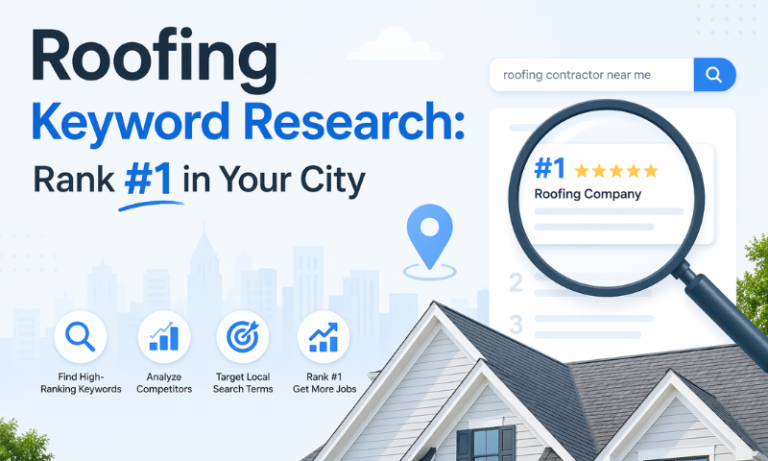
What is roofing keyword research?
Roofing keyword research is the process of finding the exact search terms homeowners and property managers use to find roofing services β repair, replacement, storm damage, maintenance β so your website ranks #1 in your city and generates inbound leads 24/7.
Most roofing companies rely on word-of-mouth and door-knocking. Meanwhile, their competitors are quietly pulling in 20β40 qualified leads per month from Google β without spending a dollar on ads. The difference? They did their roofing keyword research properly. This guide is the most practical breakdown of roofing keyword research you’ll find in 2026. No fluff. No tool demos. Just the exact keyword categories, real examples, and a process you can start using today to rank #1 in your city.
Why Roofing Keyword Research Is Different From Any Other Niche
Roofing is one of the highest-intent local niches on the internet. When someone searches for a roofer, they usually have an urgent problem β a leak, storm damage, or a failing roof. They are not browsing. They are ready to call.
This makes roofing keyword research uniquely powerful β and uniquely competitive. The right keyword strategy separates companies getting 3 leads a week from those getting 3 leads a day. The wrong strategy means paying for a website that nobody ever finds.
The 5 Roofing Keyword Categories You Must Target
Proper roofing keyword research covers every service a homeowner might need β not just “roofing company near me.” Here are the five core categories, each with real keyword examples you can use right now.
π§ 1. Roof Repair Keywords
Repair keywords drive the highest volume of emergency calls. These are homeowners with an active problem β a leaking roof after rain, a missing shingle, a sagging ceiling. Your roofing keyword research must prioritize these.
βοΈ 2. Storm Damage Roofing Keywords
Storm damage keywords are seasonal gold. After hail, heavy rain, or high winds, search volume for these terms can spike 400β600% overnight. If your roofing keyword research includes these, you capture leads at the exact moment demand explodes.
Top Storm Damage Keywords to Target:
Create a dedicated storm damage landing page before storm season. Pre-ranking this page means you capture traffic the moment severe weather hits your market β competitors scrambling to create pages will be weeks behind you.
π 3. Roof Maintenance Keywords
Maintenance keywords are underused in roofing keyword research β and that’s exactly why they’re an opportunity. Lower competition, steady year-round volume, and they attract homeowners before a problem becomes a crisis (making them easier customers to close).
ποΈ 4. Roof Replacement & Material Keywords
These keywords target homeowners in the research phase β comparing materials, getting quotes, planning a full replacement. They convert slower but produce your highest-ticket jobs. Your roofing keyword research should include material-specific terms to capture buyers at every stage.
π 5. Local Pack Roofing Keywords
These are the money keywords in roofing keyword research β terms that trigger the Google Maps 3-pack. Whoever owns these owns their market. They combine high urgency with local intent and drive direct phone calls.
How to Do Roofing Keyword Research: Step-by-Step Process
Here is the exact roofing keyword research process we use for roofing clients at Rankosys. No expensive tools required to start.
Start with a plain list: roof repair, roof replacement, storm damage, maintenance, gutter installation, skylight installation, commercial roofing. Each service = its own keyword cluster = its own landing page. This is the foundation of all roofing keyword research.
Take every service keyword and append your city, surrounding suburbs, and key neighborhoods. “Roof repair Dallas,” “roof repair Plano,” “roof repair Frisco.” One service can generate 10β20 geo-targeted keywords from a single metro area.
Type “roof repair [city]” into Google and screenshot every autocomplete suggestion. Scroll down to “People Also Ask” and “Related Searches.” These are free, real-time signals of what homeowners in your area are actually searching for. This step alone can unlock 30+ long-tail keywords for your roofing keyword research list.
Search for your main roofing keywords and check the top 3 local pack results. Click each GBP listing and note their categories, services listed, and review keywords. Then visit their website and check their page titles, H1 tags, and URL structure. Your roofing keyword research gets a massive shortcut from what’s already working for competitors.
A keyword with 50 monthly searches and transactional intent (“emergency roof repair tonight”) is worth more than a keyword with 500 searches and informational intent (“how long do roofs last”). In roofing keyword research, always weight urgency and buying intent over raw numbers.
A Denver roofing company came to us ranking for zero local keywords. After completing thorough roofing keyword research, we identified 47 target keywords across repair, storm damage, maintenance, and replacement categories. We built 8 service pages, each targeting a specific keyword cluster. Within 5 months: ranking #1 for “roof repair Denver,” top 3 for “hail damage roof replacement Denver,” and generating 28 inbound leads/month from organic search alone β zero ad spend.
Roofing Keyword Research β Frequently Asked Questions
What are the best keywords for a roofing website?
The best roofing keywords combine your service with your city β “roof repair [city],” “roofing contractor [city],” and “storm damage roofing [city]” are the highest-converting. Pair these with “near me” variants and material-specific terms like “metal roof installation” or “asphalt shingle replacement” for full coverage.
How many keywords should a roofing website target?
A well-structured roofing website should target 30β60 keywords across all service pages and blog content. Each landing page targets one primary keyword and 3β5 secondary keywords. Don’t stuff one page β build dedicated pages for each major service to maximize your roofing keyword research ROI.
Are storm damage keywords worth targeting year-round?
Yes β and you should rank before storm season, not during it. Pages take time to rank. If you build your storm damage roofing page in spring and a hailstorm hits in July, you’re already ranked. Waiting until after the storm means you miss the entire spike while your competitors take every lead.
Should roofing companies blog for SEO?
Absolutely. Blogging captures informational roofing keywords β “how much does a roof replacement cost,” “signs you need a new roof,” “how to spot hail damage on a roof.” These build topical authority, drive top-of-funnel traffic, and warm up homeowners who later become high-ticket customers.
How do I rank #1 for roofing keywords in my city?
Ranking #1 for roofing keywords requires three things working together: a fully optimized Google Business Profile with 20+ reviews, dedicated city landing pages built around your keyword research, and consistent NAP citations across 40+ local directories. Most roofing companies do one of these three. Doing all three is what puts you #1.
What tools are best for roofing keyword research?
Google Keyword Planner (free), Google Search Console (free), and Google Autocomplete (free) cover 80% of what you need. For deeper roofing keyword research, Ahrefs or Semrush add competitor keyword data and search volume filters by city β but start with free tools to build your initial keyword list before investing in paid platforms.
π Roofing SEO Specialists
Want Us to Do Your Roofing Keyword Research?
Rankosys builds complete roofing SEO keyword strategies β covering repair, storm damage, maintenance, and replacement β so you rank #1 in your city and get leads on autopilot.